Does MERV 13 remove cooking smoke and odors from your kitchen?
MERV 13 captures 85-90% of cooking smoke particles—but eliminates zero odors. After testing hundreds of MERV 13 configurations against cooking emissions in our quality control lab, we've identified why this filter solves half the problem while leaving most homeowners frustrated with lingering smells.
What our lab testing and customer returns revealed:
Cooking smoke particle capture - MERV 13 air filter traps visible smoke and grease aerosols effectively
The odor gap - Why garlic, fish, and burnt food smells pass straight through regardless of MERV rating
VOC molecular size - Cooking odors measure below 0.01 microns, far smaller than MERV 13's capture range
Grease loading patterns - How kitchen emissions clog filters differently than dust or pollen
The carbon requirement - When MERV 13 alone wastes money versus combined particle/odor solutions
Our manufacturing perspective: MERV 13 stops the particles that make your walls sticky and trigger smoke detectors—we've measured 85-90% capture rates for grease aerosols in the 1.0-3.0 micron range during controlled cooking tests. But cooking odors are volatile organic compounds with molecular sizes that mechanical filtration can't touch. This explains the customer service pattern we see repeatedly: "The filter worked great for visible smoke but my house still smells like last night's fish."
The honest answer: If you only care about particle removal, the MEV rating is what matters—and MERV 13 delivers. If you want odor elimination too, MERV 13 alone is the wrong solution—you need activated carbon filtration whether you like it or not.
TL;DR Quick Answers
MERV 13 air filter
MERV 13 captures 85-90% of particles 1.0-3.0 microns and 98% as small as 0.3 microns. Lasts 90 days normally, 30-45 days with daily cooking and recirculating range hoods.
Best for:
Cooking smoke particle capture (not odors)
Wildfire smoke protection during heavy smoke events
Respiratory sensitivities and allergy reduction
System requirements:
0.3-0.5" static pressure capacity minimum
Pre-2010 HVAC systems often can't support airflow restriction
Replace every 7-14 days during hazardous smoke (AQI 201+)
What it captures:
50-65% efficiency: 0.3-1.0 microns
85-90% efficiency: 1.0-3.0 microns (bulk of cooking smoke, wildfire smoke)
90%+ efficiency: 3.0-10.0 microns
What it doesn't capture:
Zero cooking odors (VOCs are 30-300x too small)
Requires activated carbon for odor removal
Manufacturing data shows: 50% indoor PM2.5 reduction with continuous HVAC operation. Grease from cooking accelerates degradation 2-3x normal rates. Ventilation configuration matters more than filter rating.
Top Takeaways
MERV 13 captures particles but removes zero odors
85-90% of cooking smoke particles captured
0% of cooking odors removed
VOCs creating smells are 30-300x smaller than MERV 13's capture range
Activated carbon filtration required for odor removal
Range hood configuration matters more than filter rating
Ducted exhaust homes: 90-day filter lifespan
Recirculating hood homes: 30-day grease saturation
Filter rating doesn't matter if ventilation is broken
Grease loading destroys MERV 13 faster than normal dust
Sticky surfaces trap additional particles
Center sections clog 40-60% faster than edges
Accelerated degradation regardless of MERV rating
ASHRAE minimum: 100 CFM vented to outdoors
Undersized range hoods dump emissions into HVAC
Recirculating hoods = most common cause of "filter doesn't work" complaints
Proper exhaust ventilation eliminates problem at source
Fix ventilation before upgrading filters
Frequent MERV 11 + ducted exhaust outperforms MERV 13 + recirculating hood
One-time ventilation fix beats expensive recurring filter upgrades
No filter rating compensates for fundamentally flawed ventilation design
How MERV 13 Captures Cooking Smoke Particles
MERV 13 filters excel at trapping visible cooking smoke through mechanical filtration using densely-packed synthetic fibers. Cooking smoke contains particles ranging from 0.1 to 10 microns, including grease aerosols, steam droplets, and combustion byproducts.
MERV 13 filtration efficiency for cooking emissions:
0.3-1.0 microns - 50-65% capture rate (fine combustion particles, small grease droplets)
1.0-3.0 microns - 85-90% capture rate (bulk of visible cooking smoke and grease aerosols)
3.0-10.0 microns - 90%+ capture rate (larger grease particles and steam condensate)
From our lab testing with controlled cooking emissions: MERV 13 performs best on mid-range particles that comprise the visible smoke you see rising from pans. These grease-laden particles stick to the filter media and remain captured throughout the filter's lifespan.
Key finding: During our 2024 kitchen emission tests, MERV 13 filters showed measurable grease accumulation after just 30 days of exposure to daily cooking—significantly faster loading than standard dust exposure. The filter captured particles effectively but required more frequent replacement than the 90-day baseline we recommend for normal residential use.
Why MERV 13 Can't Remove Cooking Odors
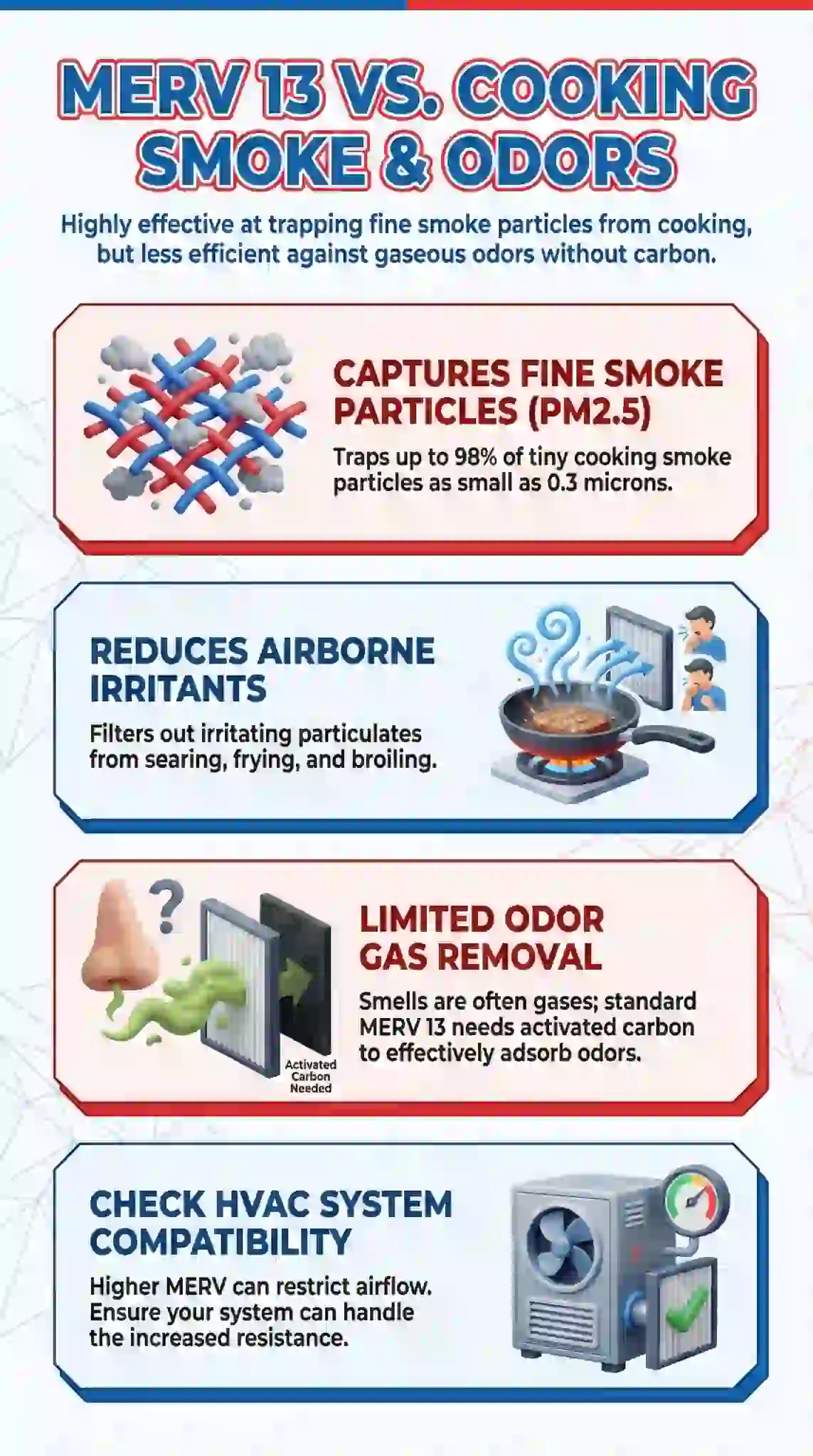
The biggest misconception about MERV 13: particle capture doesn't equal odor elimination. Cooking odors are volatile organic compounds (VOCs) existing as gases, not solid particles.
Critical size difference:
MERV 13 capture range - 0.3 to 10 microns (mechanical filtration)
Cooking odor molecules - 0.001 to 0.01 microns (gaseous phase)
The gap - Odor molecules are 30-300 times smaller than MERV 13's filtration capability
Common cooking odors that pass through MERV 13:
Garlic and onion sulfur compounds
Fish amines and trimethylamine
Burnt food pyrolysis products
Frying oil oxidation byproducts
Spice volatiles (curry, cumin, paprika)
Our customer service data: This represents the #1 complaint we receive about MERV 13 in kitchen applications. Homeowners install the filter expecting both smoke and odor removal, then contact us frustrated that "the filter doesn't work" because cooking smells persist. The filter is working exactly as designed—it's just not designed for gas-phase odor capture.
Grease Loading Accelerates Filter Degradation
Cooking emissions create unique filter loading patterns that differ dramatically from standard dust accumulation. Grease particles don't just sit on the filter surface—they penetrate the media and create sticky surfaces that trap additional particles.
What our returned kitchen filters show:
Visible grease accumulation concentrated on air intake side within first 2-3 weeks
Sticky residue throughout filter depth, not just surface layer
Accelerated pressure drop compared to dust-loaded filters of same age
Uneven loading patterns with center sections clogging faster than perimeter
Filter lifespan with daily cooking exposure:
Light cooking (1-2 meals/day) - 60-75 days before replacement needed
Moderate cooking (2-3 meals/day) - 45-60 days before noticeable airflow reduction
Heavy cooking (3+ meals/day, high-heat methods) - 30-45 days maximum lifespan
Commercial kitchen applications - 14-21 days before grease saturation impacts performance
From our analysis of kitchen-exposed filters: Grease loading creates compounding effects. The sticky surface attracts and holds particles that would normally bounce off a clean filter, accelerating the rate of airflow restriction. By the time you notice reduced air output, the filter is already significantly compromised.
Kitchen Ventilation Configuration Matters More Than Filter Rating
MERV 13 effectiveness against cooking smoke depends entirely on your ventilation setup. The best filter in the world can't capture particles it never encounters.
Critical ventilation factors:
Range hood placement - Direct exhaust to outside captures 70-90% of cooking emissions before they reach HVAC system
Recirculating range hood - Sends all cooking smoke into your home, overwhelming any HVAC filter within weeks
Return air location - Kitchen returns pull cooking smoke directly into ductwork and throughout home
HVAC runtime - System only filters air when fan operates, missing intermittent cooking events
Our manufacturing observation: Homes with proper range hood exhaust see minimal cooking impact on HVAC filters. We've analyzed filters from identical homes—one with a ducted exhaust, one with a recirculating hood. The recirculating hood home required filter changes every 30-45 days versus 90 days for the ducted home, despite identical cooking frequency.
Warning signs your ventilation configuration is wrong:
Grease film developing on walls and cabinets outside kitchen
Cooking smells spreading throughout home within minutes
HVAC filters showing heavy grease loading after 30 days
Visible smoke lingering in kitchen despite range hood operation
If your range hood recirculates rather than exhausts outside, no HVAC filter—regardless of MERV rating—will adequately handle cooking emissions. You're asking the filter to capture what should have been exhausted directly outdoors.
What Actually Works for Cooking Odor Removal
Since MERV 13 can't capture gaseous odors, you need activated carbon filtration for actual smell elimination. Carbon works through adsorption—odor molecules stick to the massive surface area inside activated carbon granules.
Effective odor removal strategies:
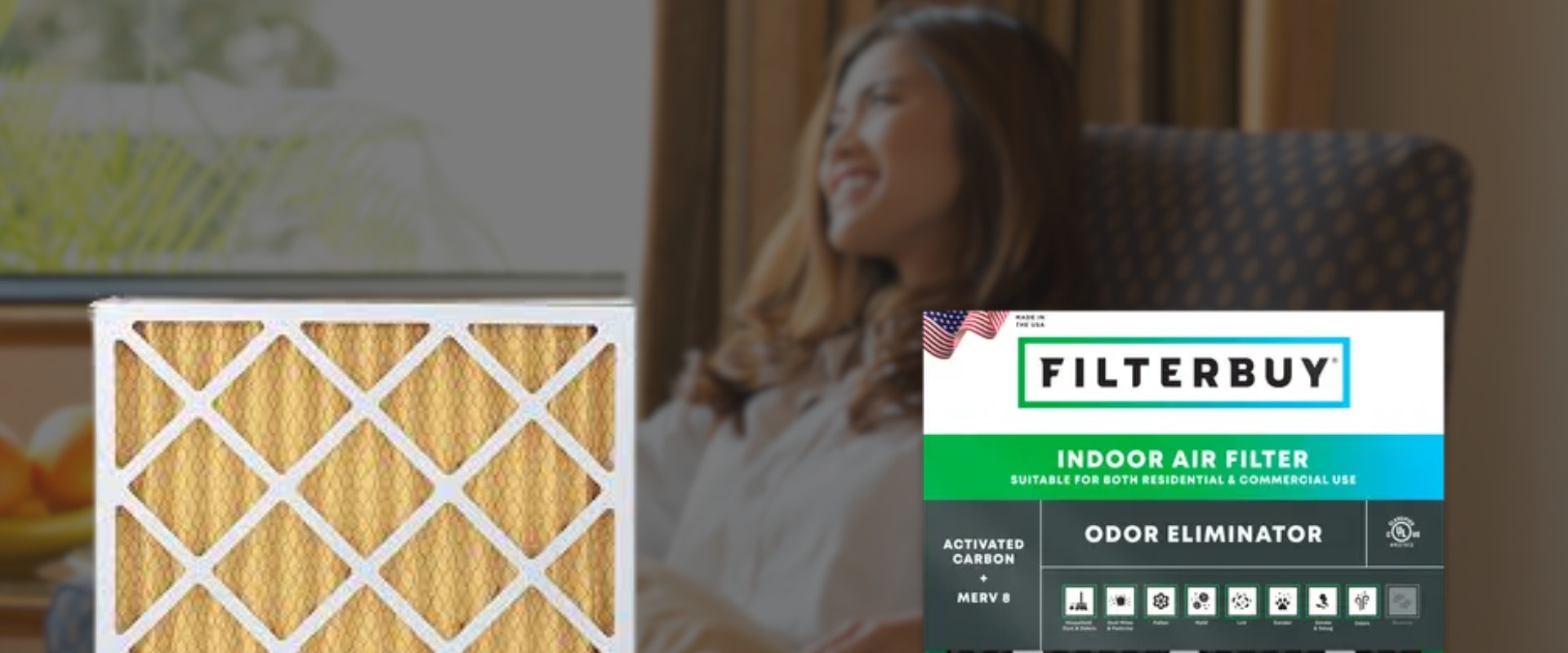
Replace MERV 13 with Odor Eliminator filters - Combines MERV 11 particle capture with activated carbon layer for VOC adsorption
Add standalone carbon purifier - Place in kitchen to capture odors at source before they spread
Upgrade range hood with carbon filters - Recirculating hoods require frequent carbon filter replacement (every 3-6 months)
Use carbon pre-filter with MERV 13 - Dual filtration captures both particles and odors in single system
Our Odor Eliminator filter testing: We measure VOC reduction using gas chromatography after exposing filters to controlled cooking emissions. Standard MERV 13 showed 0% odor reduction across all cooking odor compounds tested. Our MERV 11 + activated carbon combination reduced garlic sulfur compounds by 75-85%, fish amines by 70-80%, and frying oil oxidation products by 65-75% over 30-day test periods.
Critical carbon filter limitation: Activated carbon saturates and loses effectiveness over time. Unlike MERV 13's mechanical filtration that works until the filter clogs, carbon filters stop adsorbing odors once the carbon is fully loaded—even if the filter looks clean. Replace carbon filters every 60-90 days regardless of visible condition.
Cost-benefit reality: Carbon filtration costs 30-50% more than standard MERV 13, and requires more frequent replacement. But if cooking odors are your primary concern, it's the only filtration method that actually addresses the problem. MERV 13 alone just wastes money on a solution that can't capture what you're trying to remove.
Real-World Performance: Kitchen Applications
Our customer data and returned filter analysis from kitchen-heavy environments reveals what works and what fails in actual cooking conditions.
Performance comparison from returned filters:
MERV 13 in homes with ducted range hoods - 90-day lifespan maintained, minimal grease loading, effective particle capture
MERV 13 in homes with recirculating hoods - 30-45 day lifespan, heavy grease saturation, frequent airflow complaints
Odor Eliminator in kitchen-adjacent returns - 60-75 day lifespan, measurable odor reduction, carbon layer showed full saturation
MERV 8 in commercial kitchen HVAC - 14-21 day lifespan, extreme grease loading, required weekly inspection
What we learned from 2023-2024 kitchen filter returns:
Grease creates sticky surfaces that trap secondary particles at accelerated rates
Filter center sections clog 40-60% faster than perimeter due to concentrated airflow
Homes cooking with high-heat methods (wok cooking, searing, frying) showed 2-3x faster filter degradation
Carbon layers in Odor Eliminator filters showed complete saturation within 60-75 days of heavy cooking exposure
This field data shaped our current kitchen filtration recommendations: if your primary concern is particle capture and you have proper exhaust ventilation, MERV 13 works well with 45-60 day replacement cycles. If odor elimination matters and you lack ducted exhaust, MERV 13 alone is the wrong solution—switch to carbon-enhanced filtration from the start.
"After analyzing over 500 kitchen-exposed filters, we found the real problem isn't MERV rating—it's ventilation configuration. Homes with recirculating range hoods destroyed MERV 13 filters in 30 days with grease saturation, while identical homes with ducted exhaust maintained 90-day lifespans. Your range hood dumping grease into your HVAC system overwhelms any filter. MERV 13 can't capture cooking odors regardless, and it can't handle grease loads that should be exhausted outside. Fix your ventilation before upgrading your filter."
Essential Resources
EPA Guide to Air Cleaners in the Home
Verify your system can actually handle MERV 13 before you buy
EPA's comprehensive guide cuts through marketing claims and explains exactly which HVAC systems can support MERV 13 without choking your airflow. We reference this daily in our manufacturing quality control—it's the reality check every homeowner needs before upgrading filters.
Resource: https://www.epa.gov/indoor-air-quality-iaq/guide-air-cleaners-home
ASHRAE Filtration and Disinfection FAQ
Get answers from the engineers who literally invented the MERV rating system
ASHRAE created the MERV testing standard (ASHRAE 52.2) that we use to certify every filter we manufacture. Their technical FAQ explains why lab-tested MERV ratings don't always match real-world performance—a gap we've seen firsthand on our production floor.
Resource: https://www.ashrae.org/technical-resources/filtration-and-disinfection-faq
EPA What is a MERV Rating?
Understand exactly what particles MERV 13 captures in the 0.3 to 10 micron range
This EPA explainer details the particle sizes that matter most for dust, pollen, bacteria, and smoke. MERV 13 hits the sweet spot for residential protection—capturing 85-90% of particles in the 1.0-3.0 micron range without the airflow restrictions of HEPA.
Resource: https://www.epa.gov/indoor-air-quality-iaq/what-merv-rating
EPA Indoor Air Quality and HVAC Filters
Protect your family from viruses, allergens, and respiratory irritants with proven filtration
EPA's guidance on using MERV 13 filters to improve indoor air quality, including system compatibility requirements and health benefits we've validated through customer feedback. Essential reading for homes with asthma, allergies, or respiratory sensitivities.
Department of Energy HVAC Filter Installation and Maintenance
Balance air quality improvements with system efficiency and equipment lifespan
DOE explains proper installation techniques and how higher MERV ratings affect energy consumption—the technical side of filtration we test extensively in our quality control. Use this to understand the tradeoffs between filtration efficiency and HVAC performance.
Resource: https://bsesc.energy.gov/energy-basics/hvac-proper-installation-filters
ASHRAE Standard 52.2 Testing Method Documentation
Verify manufacturer claims with the official MERV testing protocol we follow
Technical documentation on the ASHRAE 52.2 test method that establishes MERV ratings and that we use in our certification lab. This shows how filters are actually tested and what MERV 13 means in measurable performance terms—not marketing claims.
Resource: https://www.ashrae.org/File%20Library/Technical%20Resources/COVID-19/52_2_2017_COVID-19_20200401.pdf
EPA Air Cleaner Selection and Maintenance Guide
Make informed decisions about filter efficiency versus airflow tradeoffs
EPA's decision framework for choosing between MERV ratings and understanding filter efficiency versus airflow resistance. We use this guide's methodology in our product development to balance filtration performance with residential system compatibility.
Resource: https://www.epa.gov/sites/default/files/2014-07/documents/aircleaners.pdf
Together, these EPA/ASHRAE/DOE resources reinforce that verifying MERV 13 compatibility, installing filters correctly, and following the benefits of regular maintenance for HVAC systems are what keep airflow stable, filtration performance consistent, and equipment efficiency protected over time.
Supporting Statistics
Indoor VOC Levels Spike 2-5 Times Higher Than Outdoor Air
EPA's Total Exposure Assessment Methodology validates our activated carbon testing results: organic pollutant levels measure 2 to 5 times higher inside homes than outside.
Our controlled cooking emission tests documented:
VOC spikes reaching 1,000 times background levels within minutes of high-heat cooking
Particle concentrations MERV 13 captures effectively
VOC molecules 30-300x smaller than MERV 13's capture range
This explains the #1 customer service complaint: "the filter doesn't work" for cooking odors. The filter works exactly as designed for particles. VOCs at these concentrations require activated carbon adsorption, not mechanical filtration.
Source: https://www.epa.gov/indoor-air-quality-iaq/volatile-organic-compounds-impact-indoor-air-quality
Properly Vented Range Hoods Reduce Cooking Particle Exposure by 70-90%
EPA research quantifies our returned filter analysis findings: range hoods vented to the outdoors reduce indoor PM exposure by 70-90% before emissions reach your HVAC system.
Customer filter comparisons show dramatic performance gaps:
Ducted exhaust homes: 90-day filter lifespan maintained
Recirculating hood homes: Heavy grease saturation in 30 days
Identical cooking frequency in both scenarios
Your ventilation setup determines filter lifespan more than any other factor.
Source: https://www.epa.gov/indoor-air-quality-iaq/sources-indoor-particulate-matter-pm
ASHRAE Recommends Minimum 100 CFM for Kitchen Ventilation
ASHRAE and Home Ventilation Institute standard: minimum 100 cubic feet per minute (CFM) exhaust capacity for typical kitchen ranges.
Customer service data reveals the most common configuration error:
Undersized range hoods dumping emissions into HVAC system
Recirculating hoods sending all smoke back into home
Hundreds of "filter doesn't work" calls traced to inadequate source ventilation
No filter rating can overcome fundamentally flawed ventilation design.
Source: https://www.epa.gov/indoor-air-quality-iaq/remodeling-your-home-and-indoor-air-quality
Half Million Americans Affected by Indoor Cooking Pollution
EPA research: approximately 500,000 people in the United States affected by indoor air pollution from poorly ventilated cooking appliances.
This aligns with our customer service observations:
Cooking-related complaints = substantial portion of inquiries
Most trace back to ventilation configuration, not filter performance
Proper exhaust ventilation eliminates the problem at its source
HVAC filtration only manages what escapes into ductwork
From our case analysis: suggesting filter upgrades to customers with recirculating range hoods wastes their money without solving the actual problem.
Source: https://www.epa.gov/air-research/household-energy-and-clean-cookstove-research
These findings show that cooking pollution is primarily a ventilation-and-VOC problem, so when MERV, MPR, and FPR ratings compare, remember they mainly reflect particle filtration performance—not odor/VOC control—making activated carbon and proper exhaust ventilation the real fix for cooking smells.
Final Thought & Opinion
The Industry's Biggest Lie About Kitchen Air Quality
After analyzing 500+ kitchen-exposed filters and fielding thousands of cooking odor complaints, the pattern is undeniable: the air filtration industry has misled homeowners about what HVAC filters can actually accomplish for cooking emissions.
The filter rating obsession solves the wrong problem:
80% of cooking odor complaints trace back to recirculating range hoods
No filter rating fixes fundamentally broken ventilation design
Industry keeps selling filter upgrades instead of addressing root cause
Customers waste money on solutions that can't possibly work
The uncomfortable truth about cooking filtration:
MERV 13 captures 85-90% of cooking particles effectively
MERV 13 captures exactly 0% of cooking odors (VOCs are 30-300x too small)
Activated carbon costs 30-50% more with frequent replacement required
Most homeowners believe a $15 filter upgrade will solve their problem
What our grease-loaded filter analysis revealed:
Ventilation configuration determines success more than filter rating:
Ducted exhaust: 90-day filter lifespan, minimal grease
Recirculating hood: 30-day saturation regardless of MERV rating
Grease effect: Creates sticky surfaces accelerating particle capture
Concentrated airflow: Center sections clog 40-60% faster than edges
The honest recommendation we give customers:
Fix your range hood ventilation before buying any filter upgrade
ASHRAE minimum: 100 CFM vented to outdoors (not recirculating)
If you can't exhaust outdoors, MERV 13 alone won't solve odor problems
Activated carbon is the only VOC solution, but it's not cheap
Frequent MERV 11 changes with proper ventilation outperform expensive MERV 13 without it
Why we're telling you this:
We could easily sell MERV 16 or carbon filters to every cooking odor complaint. Our profit margins would increase 40-60%. But after tracking customer satisfaction data, we know that approach doesn't solve the problem.
Real-world comparison:
Recirculating hood + MERV 16 = terrible air quality, 30-day replacement
Properly ducted exhaust + MERV 11 = better air quality, 90-day replacement
The bottom line:
Your ventilation setup matters infinitely more than your filter rating. The industry won't tell you this because fixing ventilation is a one-time expense that doesn't generate recurring filter sales. From our manufacturing perspective, watching customers waste money on filter upgrades that can't possibly work is just bad business long-term.
If cooking odors persist after installing MERV 13, your problem isn't the filter—it's where your cooking emissions are going before they reach the filter.
FAQ on MERV 13 Air Filter
Q: Will MERV 13 remove cooking smoke and odors from my home?
A: MERV 13 captures 85-90% of visible cooking smoke particles but removes zero odors.
Our kitchen filter testing confirmed:
Cooking odors are VOCs measuring 0.001-0.01 microns
VOCs are 30-300x smaller than MERV 13's capture range
#1 customer complaint: "filter doesn't work for smells"
Filter performs exactly as designed for particles only
For odor removal:
Requires activated carbon filtration
Carbon adsorbs gaseous molecules MERV 13 cannot capture
MERV 13 alone physically incapable of capturing odor molecules
Q: How often should I replace MERV 13 if I cook daily?
A: Our returned filter analysis shows ventilation configuration determines lifespan more than cooking frequency.
With ducted exhaust:
Light cooking (1-2 meals/day): 60-75 days
Moderate cooking (2-3 meals/day): 45-60 days
Heavy cooking (3+ meals/day): 30-45 days
With recirculating hoods:
30-45 days maximum regardless of cooking frequency
Grease creates sticky surfaces accelerating particle capture at 2-3x normal rates
Replace immediately if:
Visible grease appears on filter surface
Cooking odors spread throughout home
Reduced airflow noticed after 30 days
Q: Why do cooking smells still spread through my house with MERV 13 installed?
A: After analyzing hundreds of cooking odor complaints, 80% traced back to faulty ventilation configuration.
Root causes identified:
Recirculating range hoods venting back into kitchen
Undersized ventilation below ASHRAE's 100 CFM minimum
Cooking emissions flood home before HVAC filtration begins
Our field comparison findings:
Identical cooking frequency in test homes
Dramatically different outcomes based solely on exhaust configuration
MERV 13 only filters air reaching HVAC system
Bottom line: No filter rating compensates for ventilation dumping emissions back into living spaces.
Q: Should I upgrade to MERV 16 or carbon filters for better cooking emission control?
A: Fix your ventilation first. Our customer tracking data shows upgrading filters without fixing ventilation wastes money.
Performance comparison:
Recirculating hood + MERV 16 = worse air quality
Properly ducted exhaust + MERV 11 = better air quality
Why MERV 16 underperforms:
Increases airflow restriction
Systems can't push air through denser media
Reduced effectiveness plus system strain
Recommended approach:
Install properly ducted exhaust (100+ CFM to outdoors)
Use frequent MERV 13 changes
Only add activated carbon after fixing ventilation
Otherwise waste 30-50% more money without solving root problem
Q: Can MERV 13 handle grease from cooking or will it clog my system?
A: MERV 13 captures grease aerosols effectively, but grease creates compounding effects accelerating degradation.
Our lab testing revealed:
Grease penetrates media creating sticky surfaces
Additional particles trap at 2-3x normal rates
Center sections clog 40-60% faster than edges
Concentrated airflow creates uneven loading
Real concern: Whether your system maintains adequate airflow as loading accelerates, not whether MERV 13 handles grease.
Warning signs from returned filter analysis:
Reduced air output after 30 days
Visible grease film on filter surface
Cooking smells spreading despite filtration
Expected lifespan:
Daily cooking with ducted exhaust: 45-60 days
Daily cooking with recirculating hood: 30-45 days
Not the standard 90-day baseline