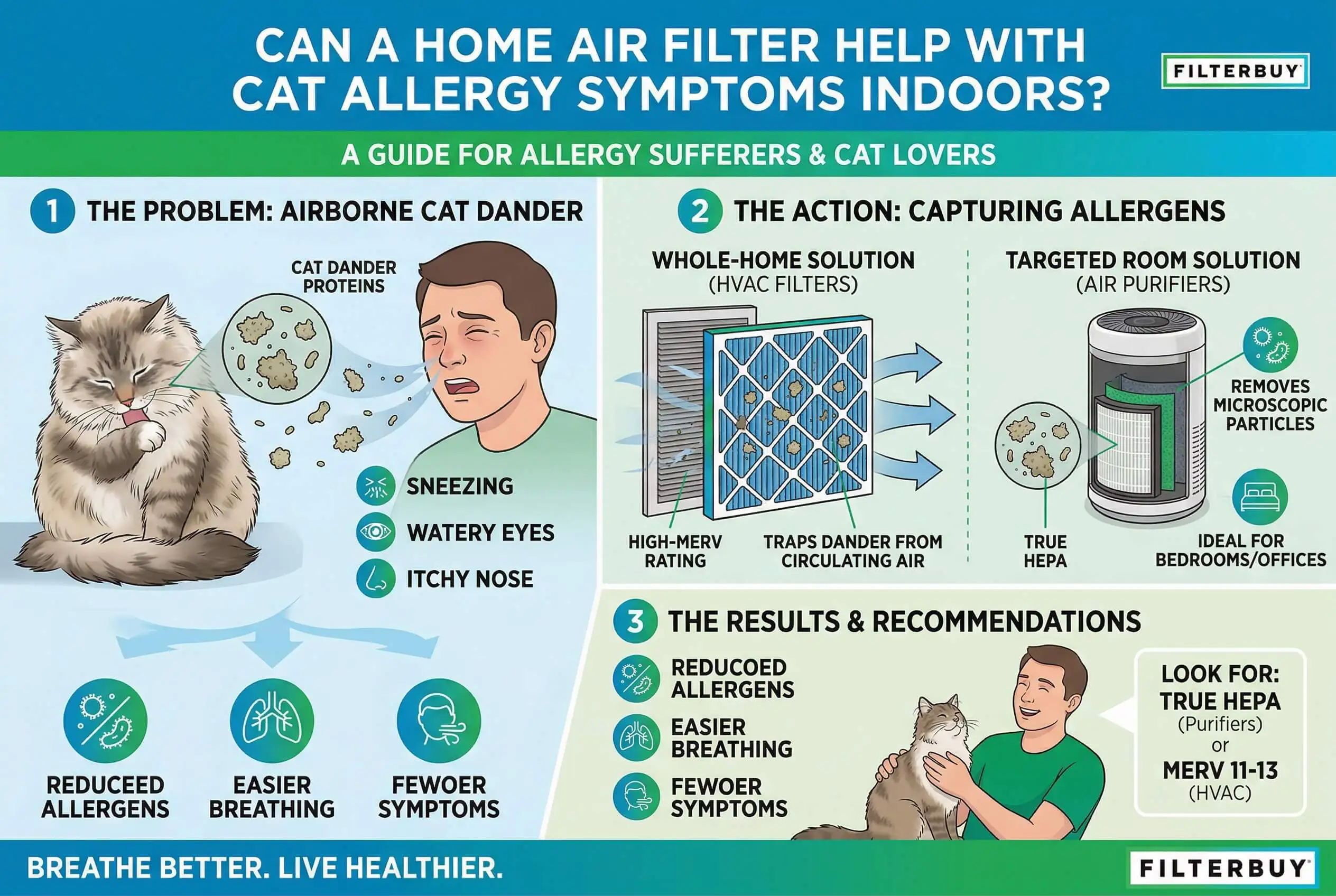
Cat allergies are not caused by fur or dander. They are triggered by Fel d 1, a microscopic protein found in cat saliva and skin secretions that becomes airborne the moment your cat grooms itself. It is so small and so light that it can remain suspended in your home's air supply for hours — long after your cat has left the room.
After manufacturing air filters for over a decade and serving more than two million households, we have learned that cat allergen relief comes down to two factors: MERV rating and airflow. Most homeowners are running filters that simply are not rated to capture particles at the size Fel d 1 travels. That gap is where allergy symptoms persist — even in clean, well-maintained homes.
This page breaks down which filter ratings actually capture cat allergens, what our customers have found works in real homes, and how to build an air filter home routine that helps your HVAC system perform at its best while keeping your indoor air cleaner, fresher, and more comfortable.
TL;DR Quick Answers
air filter home
A home air filter works by pulling indoor air through a dense filter media as your HVAC system circulates air — trapping airborne particles including pet allergens, dust, pollen, and mold spores before redistributing that air through your home.
For cat allergy households, the filter rating determines whether your system actually captures Fel d 1 — the primary cat allergen protein. After manufacturing filters for over a decade and serving more than two million households, here is what matters most:
Best MERV rating for cat allergies: MERV 11 to MERV 13
Replacement schedule with cats: Every 30 to 60 days
Most common mistake: Running a filter rated below MERV 8 — designed to protect equipment, not occupants
What filtration can achieve: Up to 76.6 percent reduction in airborne Fel d 1, per NIH clinical research
What filtration cannot do: Replace surface cleaning or eliminate allergens already embedded in soft furnishings
The right home air filter does not solve cat allergies. It reduces the concentration of what your family breathes — consistently, measurably, and on every HVAC cycle.
Top Takeaways
Cat allergies are an airborne filtration problem — not a housekeeping problem. Field 1 re-suspends into your indoor air with the slightest disturbance and recirculates every time your HVAC fan runs. Surface cleaning addresses what you can see. A properly rated filter addresses what you cannot.
MERV rating determines whether your filter actually captures cat allergens. Filters below MERV 8 are not designed to capture particles at the size Fel d 1 travels. MERV 11 is the practical starting point for most cat allergy households. MERV 13 is the stronger choice for persistent or severe symptoms.
An overloaded filter stops performing at its rated efficiency. In homes with cats, filter load builds faster than manufacturer guidelines anticipate. Check monthly. Replace every 30 to 60 days to keep your system performing at the rating on the label.
Cat allergen is present in 99.9% of U.S. homes — including homes without cats. Clinical research shows air filtration can reduce indoor Fel d 1 by up to 76.6 percent. Filter selection is one of the most impactful interventions available short of pet removal.
Filtration works best as part of a layered approach. No single strategy eliminates cat allergens entirely. The most effective households combine three things:
A properly rated MERV 11 or MERV 13 filter
A consistent 30 to 60 day replacement schedule
Targeted surface cleaning and bedroom allergen control
What Makes Cat Allergens Different From Other Indoor Pollutants
Most indoor allergens settle. Cat allergens do not.
Fel d 1 — the primary protein responsible for cat allergy symptoms — is unusually small and electrically charged. Unlike dust or pollen, it bonds easily to surfaces and fabrics, but it also re-suspends into the air with the slightest disturbance, which is why pleated furnace filters can play such an important role in capturing airborne particles. Walking across a room, running a ceiling fan, or simply turning on your HVAC system can send Fel d 1 particles airborne again within seconds.
This behavior is what makes cat allergens particularly difficult to manage — and why surface cleaning alone rarely eliminates symptoms. To reduce airborne exposure, the air itself has to be filtered.
How Air Filters Capture Cat Allergens
Air filters work by pulling airborne particles through a dense filter media as your HVAC system circulates air. The finer the filter media, the smaller the particles it can trap — including proteins like Fel d 1.
Filtration efficiency for airborne allergens is measured by MERV rating. After manufacturing filters across the full MERV spectrum and working with millions of households, we have found that MERV 11 is the practical starting point for cat allergen capture in most residential systems. MERV 13 offers stronger filtration and is what we typically recommend for households where allergy symptoms are persistent or severe.
Filters rated below MERV 8 are not designed to capture particles at the size Fel d 1 travels. Running one of those filters in a home with cats is the single most common gap we see between homeowners who get relief and those who do not.
Which MERV Rating Works Best for Cat Allergy Relief
For most households with cats, the effective MERV range is 11 to 13.
MERV 11 captures a broad range of fine particles including pet dander and most airborne allergens. It is compatible with the majority of residential HVAC systems and offers a meaningful upgrade over standard one-inch filters without restricting airflow.
MERV 13 provides hospital-adjacent filtration efficiency and captures smaller particles more consistently. It is the stronger choice for allergy sufferers but should be confirmed compatible with your system before switching, as higher-rated filters create more resistance against airflow.
Going beyond MERV 13 in a standard residential system can restrict airflow enough to reduce HVAC efficiency and strain the blower motor — a tradeoff that works against the goal of cleaner air throughout the home.
Why Filter Change Frequency Matters More Than Most Homeowners Realize
A high-MERV filter that is overloaded with trapped particles stops working like a filter. It works like a wall.
In homes with cats, we consistently see filters reach capacity faster than the manufacturer's rated lifespan — particularly during shedding seasons or in multi-cat households. A filter change interval of every 60 days is a reasonable baseline for single-cat homes. Homes with two or more cats typically benefit from changing filters every 30 to 45 days to maintain consistent allergen capture.
Checking your filter monthly and replacing it when the media appears visibly grey or discolored is a reliable rule of thumb that requires no guesswork.
What Air Filters Cannot Do on Their Own
Air filtration is one part of a layered approach to cat allergen management — not a complete solution by itself.
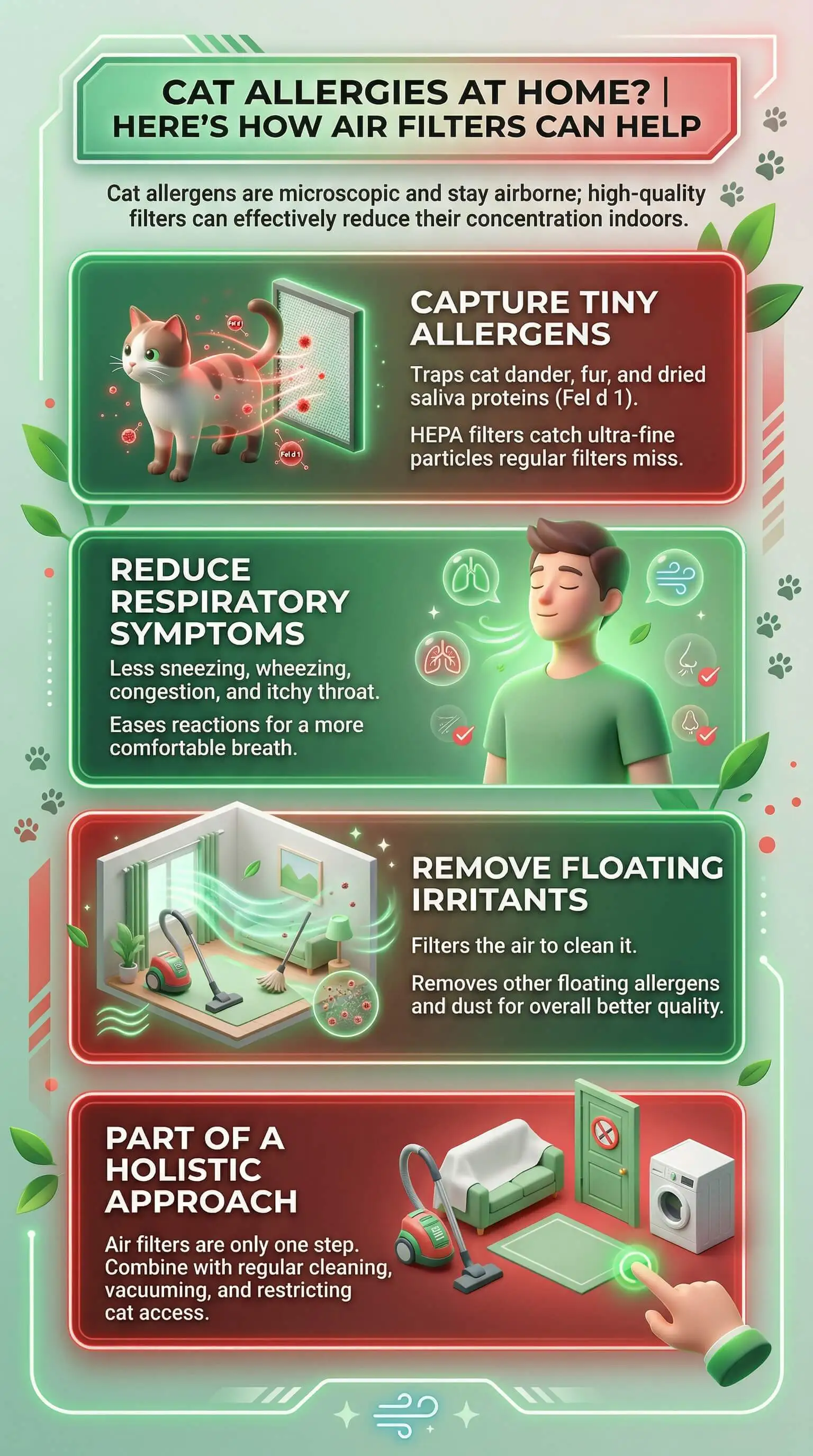
Your HVAC filter can only capture what passes through it. Allergens embedded in upholstery, carpet, and bedding require direct cleaning to remove. Bathing cats weekly has been shown to reduce airborne Fel d 1 levels, and keeping cats out of bedrooms creates at least one allergen-reduced space for recovery during sleep.
In our experience, households that combine a high-MERV filter with regular replacement and a few basic behavioral habits consistently report better results than those relying on filtration alone.
"Most cat owners we hear from have already tried everything — new cleaning routines, air purifiers, even considering rehoming their pet. What they have not tried is the right filter. After manufacturing across the full MERV spectrum and seeing the data from millions of households, the pattern is consistent: homes running a MERV 11 or higher with regular replacements report noticeably fewer symptoms than those running standard one-inch filters. Fel d 1 is not a housekeeping problem. It is an airflow and filtration problem. Once homeowners understand that, the solution becomes a lot clearer."
Essential Resources
At Filterbuy, we are obsessed with making the invisible visible — and when it comes to cat allergens, most of what is affecting your family's air quality cannot be seen, smelled, or felt until symptoms are already taking hold. After manufacturing filters for over a decade and serving more than two million households, we know that informed homeowners make better filtration decisions. These seven resources will give you the foundation to do exactly that.
1. The Filter Basics Every Cat Owner Needs to Get Right
U.S. Environmental Protection Agency — Guide to Air Cleaners in the Home
Most homeowners choose a filter without understanding what MERV ratings actually measure or how mechanical filtration captures airborne proteins like Fel d 1. The EPA's guide cuts through the confusion — explaining how air filters work, what efficiency ratings mean in practice, and what to look for when protecting your home from airborne allergens. In our experience, this is the resource that changes how people think about filters entirely.
https://www.epa.gov/sites/default/files/2014-07/documents/aircleaners.pdf
2. Why Cat Allergens Are Harder to Control Than You Think
U.S. Environmental Protection Agency — Biological Pollutants' Impact on Indoor Air Quality
Here is something most cat owners do not realize: Fel d 1 does not behave like ordinary household dust. It stays airborne far longer, travels farther, and recirculates through your HVAC system every time the fan runs. The EPA's biological pollutants resource explains exactly how pet allergens enter, move through, and accumulate in your indoor air — and why surface cleaning alone will never be enough to protect your family.
https://www.epa.gov/indoor-air-quality-iaq/biological-pollutants-impact-indoor-air-quality
3. The Hard Data Behind MERV Ratings and Cat Allergen Reduction
U.S. Environmental Protection Agency — Residential Air Cleaners: A Summary of Available Information
We are not going to tell you a higher-rated filter is always better without showing you the evidence. This EPA technical document compares predicted allergen reduction rates across the full MERV spectrum — from MERV 7 through HEPA — specifically for cat and dust mite allergens. It is the data that informs how we think about filter recommendations for allergy households, and it is the most straightforward way to understand what a MERV upgrade will actually do for your indoor air.
https://www.epa.gov/indoor-air-quality-iaq/residential-air-cleaners-summary-available-information
4. What Allergists Actually Say About Living With Cats
Asthma and Allergy Foundation of America — Pet, Dog, and Cat Allergies
The Asthma and Allergy Foundation of America is the oldest and most authoritative patient organization for allergy sufferers in the country. Their guidance on cat allergies goes beyond filtration — explaining the biology of Fel d 1, why symptoms persist even in clean homes, and what a layered approach to allergen management actually looks like. If you are serious about protecting your family's health, this is the resource that puts air filtration into the right context.
https://aafa.org/allergies/types-of-allergies/pet-dog-cat-allergies/
5. How a Simple Filter Maintenance Routine Protects Your Family Long-Term
Asthma and Allergy Foundation of America — Steps to Improve Your Home's Indoor Air Quality
In our experience serving households with pets, the most common missed step is not choosing the wrong filter — it is failing to replace it often enough. The AAFA's indoor air quality guide connects consistent filter maintenance directly to better allergy and asthma outcomes. It is the resource that turns a one-time upgrade decision into a long-term protection habit — exactly the kind of proactive approach that keeps your home's air working for your family, not against them.
6. Clinical Proof That Air Filtration Reduces Cat Allergens in Real Homes
National Institutes of Health / PubMed Central — Effect of Air Filtration on House Dust Mite, Cat, and Dog Allergens
We always back our recommendations with evidence — and this peer-reviewed study from the National Institutes of Health is among the most specific available on what air filtration actually achieves for Fel d 1. Researchers measured cat allergen levels in 22 bedrooms with and without filtration and found a median reduction of 76.6% for Fel d 1. That is the kind of result that moves the needle for households where allergy symptoms have been persistent and difficult to manage.
https://pmc.ncbi.nlm.nih.gov/articles/PMC9022093/
7. The Industry Standard That Defines Every MERV Rating on Every Filter
ASHRAE — Filtration and Disinfection FAQ
When we say a filter is rated MERV 11 or MERV 13, that rating comes from a testing standard developed by ASHRAE — the American Society of Heating, Refrigerating and Air-Conditioning Engineers. Understanding what MERV ratings actually measure, and what filter efficiency your HVAC system can realistically accommodate, is what separates a smart upgrade from one that restricts your airflow and strains your equipment. This resource is where that knowledge lives.
https://www.ashrae.org/technical-resources/filtration-and-disinfection-faq
Because cat allergens like Fel d 1 can quickly recirculate through indoor air, understanding the benefits of regular maintenance for HVAC system performance is essential to keeping your home cleaner, healthier, and better protected from ongoing allergen exposure.
Supporting Statistics
In over a decade of manufacturing filters, the data on cat allergens consistently catches homeowners off guard. Most people underestimate both the scale of the problem and the measurable impact the right filter can have. Here is what the research shows — and what it means in a real home.
Cat Allergen Is Present in Nearly Every U.S. Home — Including Those Without Cats
A nationally representative NIH study found Fel d 1 in 99.9% of U.S. homes sampled — despite a cat living in fewer than half of those homes in the previous six months.
We reference this statistic often when customers say their symptoms do not make sense because they keep a clean home. Here is why it does make sense:
Cat allergen travels on clothing and embeds in upholstery
It recirculates through shared ventilation systems for months
Cleanliness addresses what you can see — a properly rated filter addresses what you cannot
Source: National Institutes of Health / PubMed Central — Dog Allergen (Can f 1) and Cat Allergen (Fel d 1) in US Homes https://pmc.ncbi.nlm.nih.gov/articles/PMC5516632/
Pet Allergies Affect Up to 20 Percent of the Global Population — and Most Still Live With Pets
Two statistics define the scale of this problem:
The Asthma and Allergy Foundation of America reports cat and dog allergies affect 10 to 20 percent of the global population
The National Institute of Environmental Health Sciences confirms more than 50 percent of U.S. households have a dog, cat, or both — and pet allergens are detectable in virtually all American homes regardless of pet ownership
What that overlap tells us is something we see play out across the households we serve every day. Millions of Americans are managing allergy symptoms in the same homes where the allergen source lives. Pet removal is rarely a real option. That is exactly why MERV rating selection and filter replacement frequency matter as much as they do — for most families, filtration is not a preference. It is the primary tool available.
Sources: Asthma and Allergy Foundation of America — Pet, Dog, and Cat Allergies https://aafa.org/allergies/types-of-allergies/pet-dog-cat-allergies/
National Institute of Environmental Health Sciences — Pet Allergens https://www.niehs.nih.gov/health/topics/agents/allergens/pets
Americans Spend 90 Percent of Their Time Indoors — in Air That Runs 2 to 5 Times More Polluted Than Outside
The EPA reports two findings that every cat allergy household should understand:
Americans spend approximately 90 percent of their time indoors
Indoor pollutant concentrations are often 2 to 5 times higher than typical outdoor levels
For cat allergy households, that means one thing: your HVAC system is continuously recirculating Fel d 1 through every room it serves. Serving over two million households has shown us that the homes where symptoms are most persistent share two common traits:
The filter MERV rating is too low for the allergen load in the home
The filter has been left in place well past its effective lifespan
The enclosed indoor environment amplifies the problem. The right filter on the right schedule is what interrupts it.
Source: U.S. Environmental Protection Agency — Indoor Air Quality https://www.epa.gov/report-environment/indoor-air-quality
Clinical Research Shows Air Filtration Can Reduce Fel d 1 by Up to 76.6 Percent
The clinical evidence is specific and actionable:
A peer-reviewed NIH study of 22 residential bedrooms found a median Fel d 1 reduction of 76.6 percent with air filtration in place
EPA technical guidance reports predicted cat allergen reductions ranging from 20 percent at MERV 7 to 60 percent with a HEPA filter
That spread is what we want every homeowner to understand. The filter in your system right now is not neutral. After manufacturing filters across every MERV rating and hearing directly from households managing pet allergies, the gap between a MERV 8 and a MERV 13 is not a minor technical distinction. For allergy sufferers, it is the difference between a filter that protects and one that simply exists—just as in cities most prepared to work from home, the right support system makes all the difference.
Sources: National Institutes of Health / PubMed Central — Effect of Air Filtration on House Dust Mite, Cat, and Dog Allergens https://pmc.ncbi.nlm.nih.gov/articles/PMC9022093/
U.S. Environmental Protection Agency — Residential Air Cleaners: A Summary of Available Information https://www.epa.gov/indoor-air-quality-iaq/residential-air-cleaners-summary-available-information
Final Thoughts
After manufacturing air filters for over a decade and serving more than two million households, we have a clear opinion on this topic — one most filter companies will not say out loud.
A home air filter is not a cure. It is not a guarantee. What a properly rated filter does — consistently and measurably — is reduce the concentration of Fel d 1 cycling through your indoor air. That reduction matters. But it works best when the homeowner understands what they are actually managing.
Here is our honest take after years of working directly with allergy households:
1. The filter rating gap is the most underestimated variable in the home.
Most residential systems ship with filters rated between MERV 1 and MERV 4
Those ratings are designed to protect equipment — not occupants
Homeowners still struggling after upgrading their cleaning routines are almost always still running filters in that range
Upgrading to MERV 11 or MERV 13 is the single most impactful change most cat allergy households can make
2. Replacement frequency is where most filtration strategies quietly fail.
A MERV 13 filter loaded with trapped particles does not filter at MERV 13 efficiency
In homes with cats, filter load builds faster than manufacturer guidelines anticipate
Monthly checks and 30 to 60 day replacement cycles are not overcautious — they are what keeps the system performing
3. Cat allergen behaves differently than most homeowners expect.
It is lighter, stickier, and more persistent than common household dust
It re-suspends with the slightest air movement
It recirculates every time your HVAC fan runs
Surface cleaning was never designed to address an airborne problem
The broader point — and the one we feel most strongly about — is this: indoor air quality responds to deliberate decisions. The right filter rating. The right replacement schedule. An honest understanding of what a filter can and cannot do.
Homeowners who approach it that way consistently report better outcomes than those who treat it as a one-time fix.
You are not powerless against cat allergens in your own home. You are one informed decision away from a filtration strategy that actually works.
FAQ on Air Filter Home
Q: What is the best home air filter for cat allergies?
A: MERV 11 is the practical starting point. MERV 13 is the stronger choice for persistent or severe symptoms.
After manufacturing filters for over a decade, we know the gap between a standard one-inch filter and a MERV 11 is not a minor upgrade. It is the difference between a filter built to protect your HVAC equipment and one built to protect the people breathing the air inside it.
Filters below MERV 8 are not designed to capture particles at the size Fel d 1 travels. That mismatch is the most common reason cat allergy households are still struggling — even after trying everything else.
MERV 11: Practical starting point for most residential systems. Captures pet dander and fine airborne allergens without restricting airflow
MERV 13: Stronger choice for persistent or severe symptoms. Captures Fel d 1 more consistently across a broader particle size range
Below MERV 8: Not designed for cat allergen capture. Protects equipment — not occupants
Q: How often should I change my home air filter if I have cats?
A: More often than the label says.
In homes with cats, filter load builds faster than standard manufacturer guidelines anticipate — especially during shedding seasons. What that means in practice:
Single-cat home: Replace every 60 days
Multi-cat home: Replace every 30 to 45 days
Every home: Check the filter monthly regardless of schedule
A MERV 13 filter choked with trapped particles does not filter at MERV 13. It filters at whatever efficiency an overloaded filter delivers. The replacement schedule is what keeps the rating on the label working in your home.
Q: Can a home air filter remove cat allergens from the air completely?
A: No — and we will not pretend otherwise.
What a properly rated filter does is measurably reduce Fel d 1 concentration in your indoor air. A peer-reviewed NIH study found a median Fel d 1 reduction of 76.6 percent in bedrooms with air filtration in place. That is meaningful. It is not elimination.
Cat allergen also embeds in surfaces your HVAC filter cannot reach. The households that get the best results combine all four of these:
A MERV 11 or MERV 13 filter running consistently
A 30 to 60 day replacement schedule
Regular cleaning of high-contact soft furnishings
Keeping cats out of bedrooms where possible
Your home air filter is your primary airborne defense. Build the rest of your strategy around it.
Q: Does the MERV rating on a home air filter really make a difference for cat allergies?
A: Yes. It is the single most important variable in the equation.
EPA technical guidance shows predicted indoor cat allergen reductions ranging from 20 percent at MERV 7 to 60 percent with a HEPA filter. That spread represents real symptom differences in real homes.
After manufacturing across the full MERV range, here is what that data means in practice:
A low-MERV filter is not failing when it misses cat allergens — it is doing exactly what it was designed to do
It just was not designed with Fel d 1 in mind
Matching your filter rating to your actual allergen load is the decision that changes what your family breathes
That upgrade costs less than most households expect
Q: Will a home air filter help with cat allergies even if the cat stays in the home?
A: Yes — and that is the situation most cat allergy households are actually managing.
The Asthma and Allergy Foundation of America recognizes that most people with cat allergies choose not to rehome their pets. For those families, consistent air filtration is not a secondary option. It is the primary one available.
Here is why consistent filtration works even with the cat still in the home:
Every HVAC cycle pulls airborne Fel d 1 through your ductwork
A properly rated filter intercepts a meaningful share of that allergen load on every cycle
Over time that reduction accumulates into sustained symptom improvement
Serving over two million households has shown us that families who get lasting relief treat filtration as a routine — not a one-time fix. Right MERV rating. Consistent replacement schedule. That combination works even when the cat stays.
Ready to Reduce Cat Allergens in Your Home's Air Supply?
Finding the right air filter for cat allergy relief starts with the correct MERV rating for your home — and Filterbuy makes it simple to get there. Shop our full selection of MERV 11 and MERV 13 filters, manufactured in the USA and delivered directly to your door, and take the first step toward cleaner air for your family today.