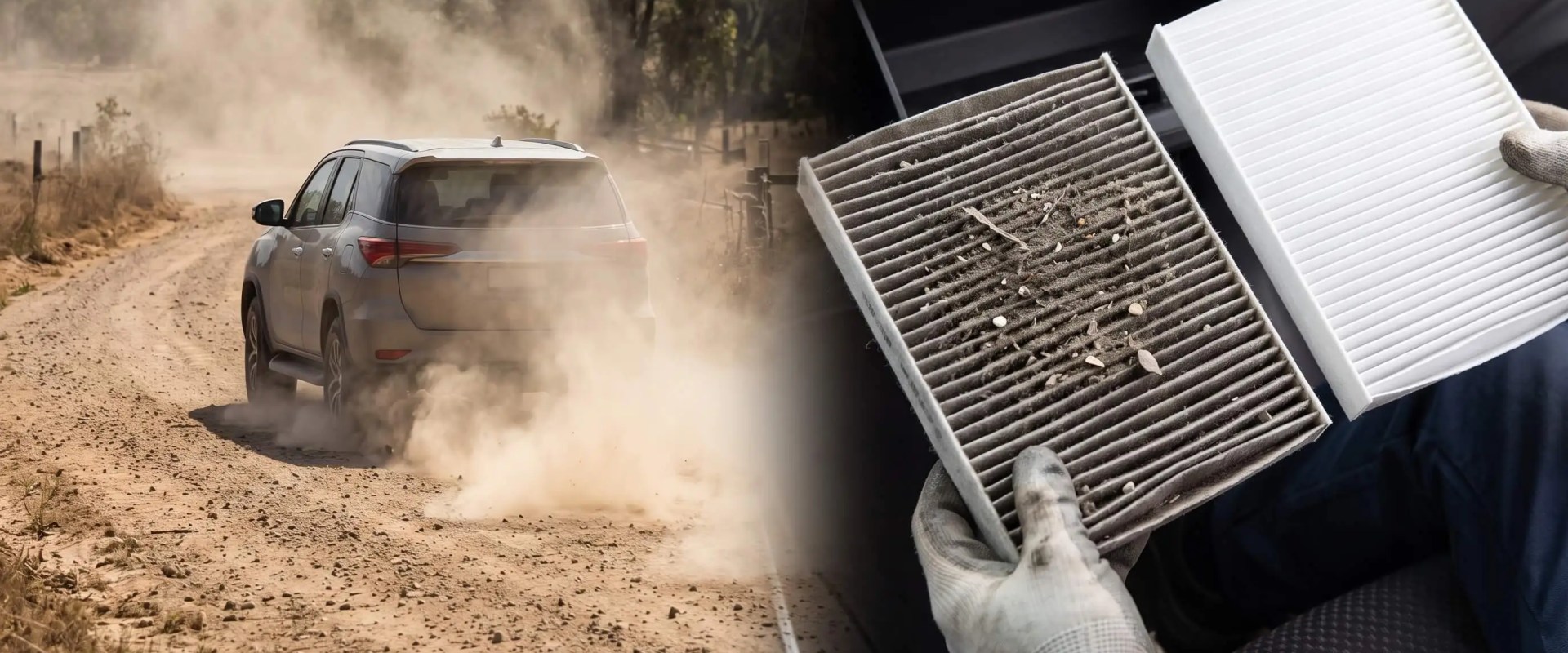
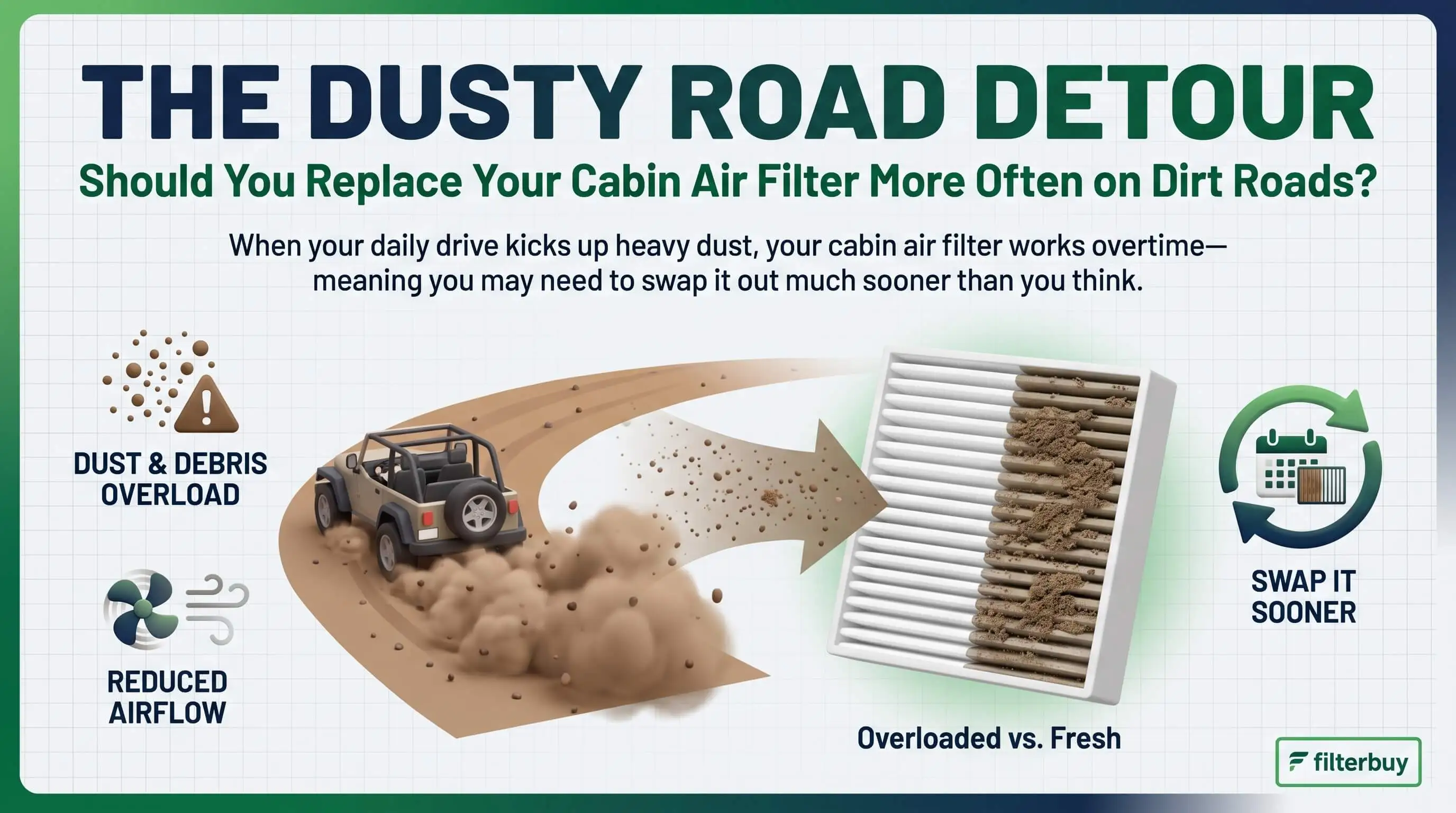
So should you replace it more often? Yes. A cabin filter wears out by the dust it catches rather than the miles on the odometer, and an unpaved road throws far more dust at it per mile than pavement does. Don't take the air inside your car for granted. A few minutes of checking keeps everyone in the car breathing cleaner air.
TL;DR Quick Answers
cabin air filter replacement
Cabin air filter replacement means swapping out the pleated filter, usually behind the glove box, that cleans outside air before it reaches your vents. Most drivers should replace it every 12,000 to 15,000 miles or about once a year. Do it sooner on dirt roads, where dust load wears a filter out faster than mileage does.
Standard interval: Every 12,000 to 15,000 miles, or about once a year, unless your owner’s manual says otherwise.
Replace sooner: Gravel, dirt, or construction-zone driving, wildfire smoke, or heavy pollen seasons.
Quick check: Hold the filter up to a bright light at each oil change. If light barely passes through the pleats, it’s done.
Warning signs: Weak vent airflow, dust settling back on the dash, musty odors when the fan starts, slow defrosting.
Right replacement: Match the OEM part number. Choose particulate media for dust and pollen, or activated carbon to also cut exhaust fumes and odors.
Clean or replace: Replace it. Most cabin filters are disposable, and cleaning leaves fine particles packed in the media.
Top Takeaways
Most owner's manuals list dirt and gravel roads as severe driving and call for more frequent cabin filter changes.
The standard 12,000 to 15,000 mile interval assumes pavement. On dusty roads, treat it as a ceiling.
Check the filter at every oil change and replace it when light barely passes through the pleats.
Your manual may call it a dust and pollen filter, a passenger compartment air filter, or an in-cabin microfilter.
Recirculation mode, closed windows, and extra following distance all slow how fast the filter loads up.
How Dirt Roads Change Your Cabin Air Filter Schedule
Why Unpaved Roads Load a Filter So Fast
Tires grind an unpaved road into powder one pass at a time. EPA's AP-42 method for estimating unpaved road emissions spells out the mechanism. Wheel force pulverizes the surface, and the turbulent wake behind each vehicle keeps lifting that material after the car has gone by. Roads with more fine silt put more of it in the air.
Your car's fresh-air intake sits in the cowl just below the windshield, in the band where road dust hangs thickest. Trail another vehicle down a county road and your filter swallows its dust plume for the entire drive. Much of that dust is PM10, particles 10 micrometers and smaller. Some are finer PM2.5, small enough to travel deep into the lungs. Stopping it is the filter's whole job.
What Your Owner's Manual Calls Severe Driving
Most owner's manuals print two maintenance schedules, one for normal driving and one for severe. Rough, dusty, muddy, unpaved, or graveled roads put you in the severe column. Hyundai's manuals list exactly that condition, then tell owners to replace the cabin air filter "more frequently" without giving a number. Nissan's maintenance guides say the same about dusty roads.
Finding the right page can be a puzzle of its own, because many automakers never print the words "cabin air filter." Check your manual's index for these names instead.
Dust and pollen filter: Honda
Passenger compartment air filter: Chevrolet, GMC, Buick, Cadillac
In-cabin microfilter: Nissan
Climate control air filter: Hyundai
Air conditioning filter: Subaru
Signs Your Cabin Filter Is Already Clogged
Weak airflow from the vents, even with the fan on high.
A dust film that settles back on the dash a day or two after you wipe it.
A musty, earthy smell when the fan first kicks on.
Windows that fog up and clear slowly because the defroster can't push enough air.
A blower that sounds louder than it used to while moving less air.
Spot any one of these on a car that sees dirt roads, and it's time to pull the filter and look.
A Practical Schedule for Dirt and Gravel Road Drivers
Most guidance says to replace a cabin filter every 12,000 to 15,000 miles, or about once a year. That schedule assumes paved driving. When gravel or dirt is part of my week, I treat that number as a ceiling and let the filter itself tell me when it's done.
Check it at every oil change. On most vehicles it sits behind the glove box, a few minutes' work.
Hold it up to a bright light. When light barely passes through the pleats, or the face has turned a uniform gray-brown, replace it.
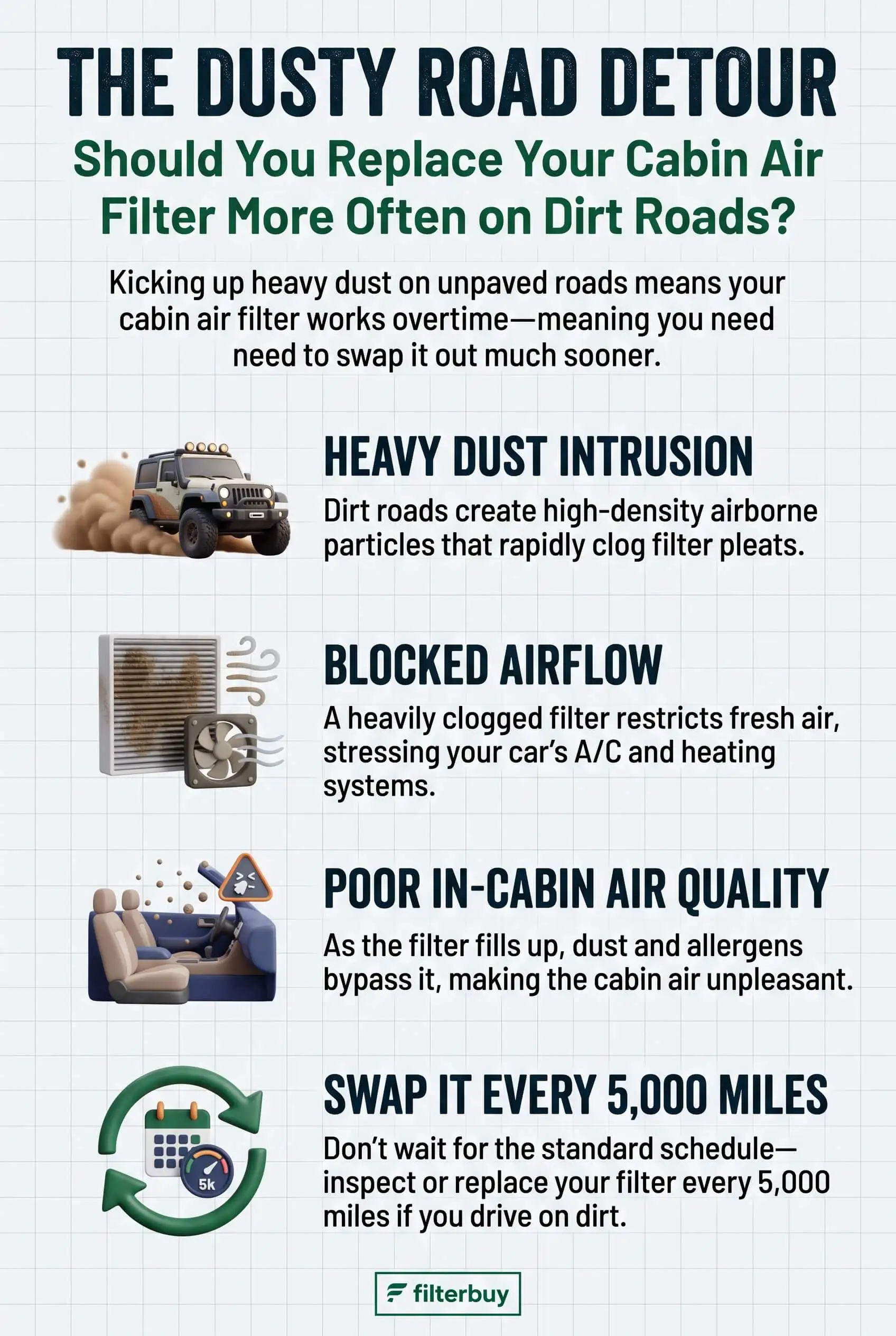
Expect about six months between changes if unpaved roads are part of your weekly routine, roughly twice the usual pace.
Swap it after a heavy-dust stretch like a long backroad trip or harvest season, even if the calendar says you have time left.
Write the date and mileage on the frame when you install it, so the next check starts with a baseline.
Choosing the Right Replacement
Two filter types cover most drivers. A particulate filter traps dust and pollen. An activated carbon filter traps the same particles and adds a carbon layer that adsorbs exhaust fumes and odors, which earns its keep when your dirt road ends at a busy highway or runs past livestock and freshly worked fields. For dust alone, particulate capture does the heavy lifting.
Fit matters as much as media. When replacing the air filters, match the replacement to your OEM part number, or to your vehicle's year, make, and model, so it seals tight in the housing. Any gap around the frame lets dust slip past and wastes the effort of changing it more often. If you drive unpaved roads every week, keep a spare on the shelf and the next swap won't wait on a parts run.
Habits That Stretch Filter Life on Dusty Roads
Switch to recirculation on gravel stretches, then back to fresh air once you hit pavement. Hours on recirculation can fog the windows and let carbon dioxide build up in the cabin.
Hang back from the vehicle ahead. Its dust plume is the dirtiest air on the road.
Keep the windows up. An open window lets dust skip the filter completely.
Ease off the gas. Slower tires kick up less dust, yours and the road's.
The Dust You Bring Home
Dirt-road dust rides home on your clothes and shoes, and some of it lands in your home's return vents. Heavy dust shortens a home filter's life the same way. My guide to filters in homes with renovation dust shows how quickly that happens, and The Ideal HVAC Filter Replacement Schedule for Every Home covers the household timeline. If you're comparing higher-efficiency home filters, start with what a MERV rating actually measures.
"After pulling cabin filters from cars that run gravel roads every day, I quit trusting the odometer. A dirt-road filter at 6,000 miles usually looks worse than a highway filter at 15,000, its pleats caked tan and packed so tight the blower can barely push air through."
7 Essential Resources
I confirmed every resource link below live on October 14, 2026.
Cabin air filter replacement options for passenger vehicles, with particulate and activated carbon filters matched to OEM part numbers.
Particulate Matter (PM) Basics. EPA explains the difference between PM10 and PM2.5 and names unpaved roads as a direct source.
AP-42 Section 13.2.2, Unpaved Roads. The federal emissions method shows how wheels pulverize a road surface and why a road's silt content drives its dust levels.
Reducing Air Pollution Exposure in Passenger Vehicles and School Buses. Researchers working for the California Air Resources Board found that in-use factory cabin filters cut in-cabin PM2.5 by about 29%, while high-efficiency prototypes cut it by about 66%.
Particle Pollution. The American Lung Association lays out what fine and ultrafine particles do to the heart and lungs.
Public Road and Street Mileage in the United States by Type of Surface. The Bureau of Transportation Statistics tracks how many public road miles are paved and how many aren't.
Car Care Council Cabin Air Filter Guidance. The council recommends a new filter every 12,000 to 15,000 miles or per the owner's manual, sooner where contaminants run heavy, and advises against cleaning and reusing an old one.
3 Statistics
Each statistic below links to its live source.
Unpaved roads make up 32% of all road types in the United States. Researchers measuring hourly PM10 about 15 meters from a Midwest gravel road recorded a geometric mean of 50 µg/m³, nearly double the 26 µg/m³ at a background site. Source: Environmental Science: Atmospheres, Unpaved Road Particulate Matter Emission Rates (2024).
In a 17-taxi study, drivers who kept their windows closed and ran a high-efficiency cabin air filter cut in-cabin PM2.5 by 37% and ultrafine particles by 47% compared with no mitigation. Source: CDC Stacks, High Efficiency Cabin Air Filter in Vehicles.
In a randomized cross-over trial with 48 adult commuters, cabin air filtration lowered in-vehicle PM2.5 by 30% and ultrafine particles by 28% compared with a placebo filter. Source: PubMed Central, In-Vehicle Cabin Air Filtration Study.
Final Thoughts and Opinion
For anyone who drives dirt roads, the odometer is the wrong gauge. A weekly gravel commute can load a cabin filter with a year's worth of dust in a few months.
Here's where I land. Check the filter at every oil change, replace it as soon as light stops passing through the pleats, and plan on about twice the manual's normal pace when dirt roads are part of your week. In the studies above, a working cabin filter cut fine particles by roughly a third or more. A clogged one can't keep that up, and gravel roads close the gap between clean and clogged quickly. Even MERV 8 pleated furnace air filters used in home HVAC systems need regular replacement to maintain effective filtration.
Frequently Asked Questions
Does driving on gravel roads count as severe driving conditions?
Yes. Most owner's manuals list rough, dusty, muddy, unpaved, or graveled roads as severe driving, and that schedule calls for replacing the cabin air filter more often than the normal interval. Manuals rarely give a number, so inspection sets your pace.
Can a clogged cabin air filter hurt my car's A/C?
A clogged filter chokes airflow, so the blower motor works harder while the A/C and defroster deliver less air. That extra strain can shorten the blower's life. A fresh filter usually brings airflow back right away.
Should I use recirculation mode on dirt roads?
Recirculation helps on dusty stretches because it stops pulling outside air through the intake. Switch back to fresh air once you're on pavement. Running recirculation for long periods can fog the windows and let carbon dioxide build up inside the cabin, which can leave you drowsy.
Is an activated carbon cabin filter better for dusty roads?
For dust alone, a good particulate filter does the main work. An activated carbon filter adds odor and exhaust-fume control on top of particle capture, so it pays off when your dirt road meets busy traffic, livestock, or field spraying. As with regular HVAC maintenance, either type still needs changing more often under heavy dust.
Can I clean and reuse a dusty cabin air filter?
Most cabin air filters are disposable, and the Car Care Council advises against cleaning and reinstalling them. A vacuum leaves fine particles packed deep in the media, and water can warp the pleats. Replace it unless the filter is sold as washable.
Keep the Dirt Road Outside Your Cabin
At your next oil change, pull the cabin air filter and hold it up to the light to see how much of the road your vents have been catching. Set the next replacement according to your air filter replacement schedule and the roads you drive, and you'll keep that dust out of the air you and your passengers breathe.