Put a bench and a rack in your garage and the room changes character on you. Temperature is the obvious problem, and in August it’s a real one. But the thing that actually ends sessions in there is invisible, and almost nobody sizes for it.
So here’s my answer up front. For a home gym, buy a ductless mini split. I’ve watched plenty of people talk themselves into a portable unit instead, because it costs less and it shows up on a truck next Tuesday, and I get the logic. The problem is that a parked car sits still and cools off. You don’t. You keep producing heat and moisture for the whole length of the workout, and equipment that holds a quiet garage at 78 degrees will quietly fall behind in a garage where somebody’s working, making an HVAC air filter subscription service a convenient way to keep replacement filters on hand for routine system maintenance.
TL;DR Quick Answers
Garage air conditioner
A garage air conditioner has to fight an uninsulated box that runs 20 to 30 degrees hotter than the outside air. A ductless mini split handles that best, because it pulls moisture out while it cools. Seal the door and insulate before you size anything.
Best type: ductless mini split, quiet, and it needs no window
Typical sizing: 12,000 BTU for a one-car garage, 18,000 for a small two-car, 24,000 for a full two-car
Biggest mistake: oversizing, which short cycles and leaves the room cold but damp
Do first: garage door bottom seal, then door panel and ceiling insulation
Safety step: add a carbon monoxide alarm once an attached garage is sealed tight
Top Takeaways
A ductless mini split suits a garage gym best, because it removes moisture as steadily as it removes heat.
Square footage alone underestimates a gym. The people training in the room add heat and humidity of their own.
Oversizing causes short cycling, which leaves you with a room that’s cold and damp instead of cool and dry.
Insulation and door sealing come before equipment. Skip them and the unit spends its life fighting the building.
Sealing an attached garage raises carbon monoxide risk, so add an alarm near the connecting door.
Why a Garage Gym Is a Harder Cooling Problem Than a Garage
Most garage cooling advice treats the room as a box with bad insulation and a big metal door. Fair enough. Garages really do run 20 to 30 degrees hotter than the outside air, because the walls and the door usually have nothing in them and the space sits outside your home’s ducted system, making a properly sized garage air conditioner especially important.
Then you walk in and add a heat source the box math never counted. Moderate lifting or interval work throws off heat without pause, and your body sheds most of that heat by evaporating sweat off your skin. Evaporation needs somewhere for the moisture to go. Close the garage up, run an undersized unit, and humidity climbs until evaporation slows to a crawl. The thermostat will tell you the room is fine. Your shirt will tell you otherwise.
That gap between the reading and the reality is why I pay more attention to moisture removal than to raw temperature in these rooms. Getting a garage cold is easy. Getting it dry while somebody’s working on it is the actual job.
Garage Air Conditioner Options Compared
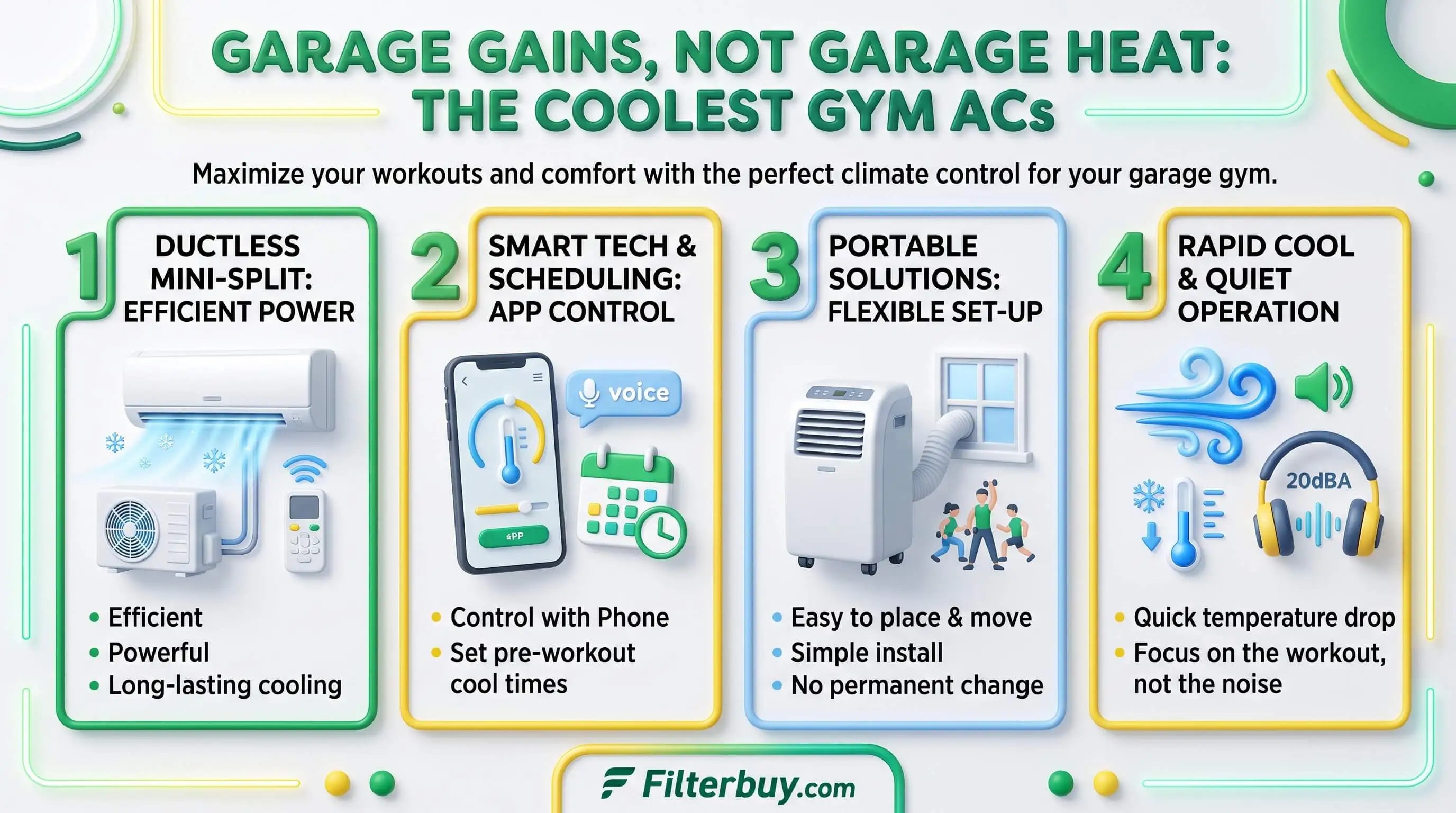
Four categories are worth your time, and the honest ranking shifts once the room gets used for training. All four run on the same vapor compression refrigeration cycle. What separates them is where the heat gets dumped and how much of your room they eat.
Portable Air Conditioners
It rolls in, plugs into a standard outlet, and vents through a hose. That convenience is real and I won’t pretend otherwise. Here’s the part most product pages skip. Single-hose designs pull their condenser air from inside the room and blow it outdoors, so hot outside air comes straight back in through every gap in the garage to replace it. In a leaky garage you’re paying for cooling that leaves before you feel it. The unit also sits on the floor, and floor space is the one thing a home gym never has spare.
Window Air Conditioners
If your garage has a usable window, a window unit is the cheapest route to genuine refrigerated air. It cools well for the money and it stays out from underfoot. The limits are real, though. Plenty of garages have no window at all, the units run loud enough to argue with your music, and across a full season the efficiency trails a ductless system by a wide margin.
Through-the-Wall Units
A sleeve unit solves the no-window problem and seals tighter than a window install ever will. You’re cutting into an exterior wall, so treat the decision as permanent. Efficiency lands somewhere between a window unit and a mini split. In a detached garage where routing a refrigerant line out to a condenser gets awkward, this is a sensible middle path.
Ductless Mini Splits
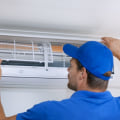
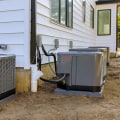
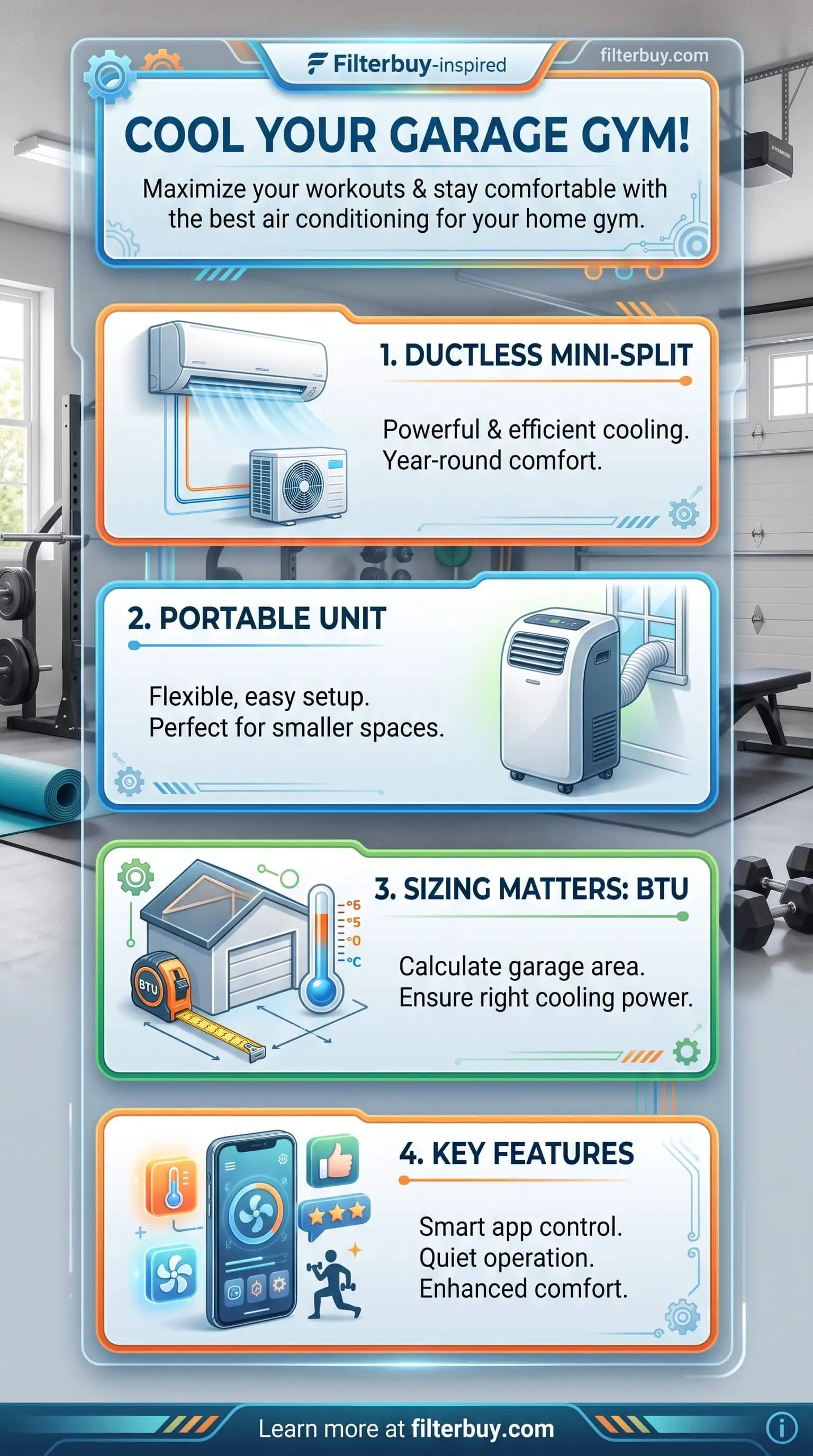
The compressor goes outside. A slim air handler mounts on the garage wall, and a small refrigerant line set connects the two. You give up no floor space, and the system needs neither ductwork nor a window. It runs quiet. More to the point, it modulates output instead of slamming on and off, and that long, low, steady run is exactly what pulls water out of the air across a full session. Most models reverse to heat as well, which you’ll appreciate in January.
If you want to see the categories side by side along with the envelope work that ought to come first, this fuller breakdown of garage cooling options lays out the sizing bands and the tradeoffs together.
Sizing a Garage Air Conditioner for a Home Gym
Start with the floor area. Then correct for the two things that make a gym different from a storage bay.
One-car garage, roughly 250 to 300 square feet. 12,000 BTU generally covers it.
Large one-car or small two-car, 350 to 400 square feet. Step up to 18,000 BTU.
Full two-car garage, 500 to 550 square feet. Plan on 24,000 BTU.
Three-car or high-ceiling space, 600 square feet and up. You’re into heavy-duty territory here, 24,000 BTU and beyond.
Now the corrections. Uninsulated walls, a bare door, or a tall ceiling all push you up a band rather than down. And if people train in that room instead of storing lawn equipment in it, add for the occupants and for the water they put into the air. Two people doing conditioning work in 400 square feet is nothing like one person on a bench.
There’s a ceiling on that logic, though, and this is the part I’d stress hardest. Oversizing is not a free hedge. A unit that’s too big satisfies the thermostat fast, shuts off, and never runs long enough to wring water out of the air. In a storage garage you’d barely register it. In a gym you’ll feel it by the second set. If you’d rather have the number calculated than guessed, ask your installer for a Manual J load calculation. Naming it out loud tends to change the conversation.
Fix These Before the Unit Goes In
Drop cooling equipment into an unprepared garage and it will run longer, cost more to operate, and still leave you disappointed. Four things come first.
Bottom seal on the garage door. Biggest single gap in the room, cheapest one to close.
Door panel insulation. A bare steel door facing the afternoon sun keeps radiating heat inward for hours after the sun has moved off it.
Ceiling or attic insulation. Heat pools at the top of the space, which happens to be exactly where your head is when you’re standing.
Air sealing on the wall you share with the house. Caulk the outlet boxes, seal the pipe penetrations, weatherstrip the connecting door.
One safety point falls straight out of that last item, and I’d rather say it plainly than bury it in a footnote. Tightening up an attached garage removes the natural dilution that made an occasional idling engine survivable, and high quality filters can support cleaner airflow when used in a compatible HVAC system. If a car parks in that space, put a carbon monoxide alarm inside the house near the connecting door, and stop warming the car up with the door down. That isn’t a caveat to the sealing work. It’s a direct consequence of doing the sealing work properly.
“The garage gyms that fail almost never fail on tonnage. They fail because somebody bought enough machines to win the temperature argument in ten minutes, then couldn’t work out why the floor was still slick an hour in.”
7 Essential Resources
See Why Garages Get Named as a Prime Ductless Application
ENERGY STAR lists sheds, barns, and garages as a leading case for ductless equipment, specifically where extending ductwork isn’t practical. Useful if you’ve been wondering whether you’re improvising. ENERGY STAR, Ductless Heating and Cooling
Size a Room Unit Without Buying Too Much Machine
If you’re going window or through-the-wall, this page states the thing most buyers get wrong. Bigger isn’t better, and sizing comes before shopping. ENERGY STAR, Room Air Conditioners
Seal and Insulate a Garage Wall the Way the Code Expects
A code-level walkthrough of sealing seams at the rim joist, top plate, sill plate, and foundation wall. It also covers what changes when there’s living space sitting above the garage. Building America Solution Center, Pacific Northwest National Laboratory
Understand What a Tighter Garage Does to Carbon Monoxide Risk
Read this before you finish the sealing work rather than after. It explains why never idling a vehicle indoors matters more once the space is tight, and what exposure actually does to you. EPA, Carbon Monoxide and Indoor Air Quality
Know the Warning Signs Before You Push Through a Hot Session
Straight guidance for anyone training in heat. Pacing, hydration, and the early signals that should stop a workout instead of postponing it. CDC, Heat and Athletes
Borrow the Engineering Controls Industrial Sites Use for Heat
Written for workplaces, but the controls carry over to a garage gym with almost no translation needed. Increase air velocity, shield the radiant surfaces, cut the humidity. NIOSH, Heat Stress Workplace Recommendations
Ask Your Installer for the Calculation That Prevents Oversizing
The ANSI standard for residential load calculation. Knowing what it’s called turns a vague sizing chat into a specific one. ACCA, Manual J Residential Load Calculation
These resources cover garage cooling, proper system sizing, insulation, heat safety, air quality, and contractor selection, with HVAC system maintenance services helping keep garage cooling equipment efficient, reliable, and properly maintained over time.
3 Statistics
Above 95 degrees with high humidity, both of your main cooling routes drop to almost nothing. Radiation at rest and sweat evaporation during exercise collapse under those conditions. That describes the garage gym scenario almost exactly. CDC Yellow Book
78 degrees is the recommended cooling setpoint. On humid days, drop the fan speed. Slower air across the coil removes more moisture. ENERGY STAR
Carbon monoxide alarms belong at least 15 feet from any fuel-burning appliance. One also belongs inside the house at the door to an attached garage, and in any room above it. EPA
These statistics highlight the importance of temperature control, humidity management, and carbon monoxide safety in a garage gym, with MERV 13 pleated HVAC furnace air filters helping support cleaner airflow when used in a compatible HVAC system.
Final Thoughts and Opinion
Here’s where I’ll plant a flag. Most people overspend on the equipment and underspend on the building. A 24,000 BTU system in an uninsulated garage with a failing door seal will lose to an 18,000 BTU system in a garage where somebody gave up one Saturday to close the envelope. Equipment is the visible purchase, so it takes attention and the budget. The building quietly decides how hard that equipment has to work for the next fifteen years.
The other idea I’d push back on is that this ranking is fixed. In a garage full of boxes and a lawnmower, a window unit is a perfectly reasonable answer and I wouldn’t argue with anyone who bought one, especially if AC replacement gives you the opportunity to upgrade to a more efficient system that better matches how the space is actually used. Once you’re sweating there four days a week, the moisture side of the job moves to the front of the list, and that’s where ductless pulls away from the rest. Same room, different job, different answer.
Frequently Asked Questions
Will a window air conditioner cool a garage gym?
It can, if you’ve got a suitable window and you size the unit correctly. Expect more noise and a higher running cost than ductless, and expect humidity to be the weak spot on longer sessions. It’s the budget answer rather than the best one.
Can I cool a garage that has no windows?
Yes. A ductless mini split needs a hole about three inches across for the refrigerant line and the condensate drain, and nothing more than that. A through-the-wall unit is the other route, though it means cutting a full sleeve opening into an exterior wall.
Does a mini split heat the garage too?
Most do. They reverse the refrigerant cycle and run as a heat pump, so one piece of equipment covers winter training as well as summer. Check the rated low-temperature performance if your winters get severe, because capacity falls as the outdoor temperature drops.
Do I need a dehumidifier as well?
Usually not. A correctly sized air conditioner running decent cycle lengths handles the moisture on its own, with top air filters helping support cleaner airflow in a compatible system. If you find yourself shopping for a dehumidifier, take it as a sign the cooling equipment is oversized and short cycling. Fix the sizing before you add another appliance and another circuit.
How much does it cost to run a garage air conditioner?
That depends on your electricity rate, the efficiency rating on the unit, and how leaky the garage is. A high-SEER2 ductless system in a sealed garage costs meaningfully less to run than a portable unit in a drafty one. No dollar figures included pending confirmation.
Can I install a mini split myself?
Some systems ship pre-charged for do-it-yourself installation. Refrigerant handling and the dedicated circuit still call for a licensed pro in most cases, and that’s the route I’d take for HVAC installation. Check your local permitting rules before you order, because an unpermitted install can turn into a problem at closing when you sell the house.
Match the Cooling to the Work You Actually Do in That Room
The best garage air conditioner for a home gym is the one sized for the training you actually do in there, not for the square footage printed on a floor plan. Walk the garage, look hard at the door seal and the ceiling, count how many people use it, and let that decide what you buy.