
Most of the clues sit in plain sight. Below are the checks in the order that saves the most time, from five-minute fixes you can handle yourself to the point where a licensed technician should take over.
TL;DR: Quick Answers
air conditioner not blowing cold air but running
An AC that runs but blows warm air is losing its fight to move heat out of your house. Most cases come down to restricted airflow, an outdoor unit that can’t release heat, or a refrigerant leak. Start with the air filter, since it’s both the most common cause and the cheapest fix.
Check the thermostat: Set it to Cool, put the fan on Auto, and set the target several degrees below room temperature. A fan left on “On” blows room-temperature air between cooling cycles.
Hold the filter up to a light: If no light passes through, replace it.
Look for ice on the copper line: Thaw it on Fan Only for several hours, then restart on Cool with a fresh filter.
Listen to the outdoor unit: If it’s silent while the indoor blower runs, check the breaker and the disconnect box.
Call a licensed technician: Ice that comes back, a breaker that keeps tripping, or hissing near the lines points to a leak or an electrical fault.
Top Takeaways
Check the thermostat, filter, and outdoor unit before anything else.
A fan set to "On" can mimic an AC that won't cool.
Frozen coils come from restricted airflow or low refrigerant.
Low refrigerant always means a leak that needs a certified technician.
Shut the system off if ice keeps returning or the breaker trips.
Is Your AC Broken or Just Losing to the Heat?
Long runtimes on a scorching day can be perfectly normal. Contractors size systems for a typical hot day in your area, so when a heat wave pushes past that mark, your AC may run for hours and still sit a few degrees above the setting. It's working flat out.
Constant running deserves a closer look when:
It happens on mild days too, and the house never reaches the set temperature, even overnight
Air at the vents feels close to room temperature
Start With the Five-Minute Checks
Rule out the easy stuff before you worry about compressors.
Thermostat settings. Make sure it's on Cool, the fan is on Auto, and the target sits several degrees below room temperature. A fan left on "On" keeps the blower running nonstop and pushes room-temperature air between cooling cycles, which feels exactly like a broken AC.
The air filter. Slide it out and hold it up to a light. If light can't get through, replace it. Long summer runtimes clog filters fast, so a filter replacement schedule built around your home beats a fixed calendar date.
The outdoor unit. Step outside and listen. When the indoor blower runs but the outdoor fan and compressor stay quiet, check the breaker and the disconnect box beside the unit. With only half the system running, the air never gets cold.
How Your AC Moves Heat
Your AC pulls heat out of your house rather than making cold air from scratch. Warm indoor air passes over the evaporator coil, the refrigerant inside soaks up that heat and carries it to the outdoor condenser coil, and the compressor keeps the whole loop under pressure. That loop is the heart of how air conditioning works.
When your house won't cool, something in that loop has broken. The sections below follow it in order, starting indoors.
Air Conditioner Not Blowing Cold Air but Running? Start With Airflow
Airflow trouble causes more of these cases than anything else, and it's usually the cheapest to fix.
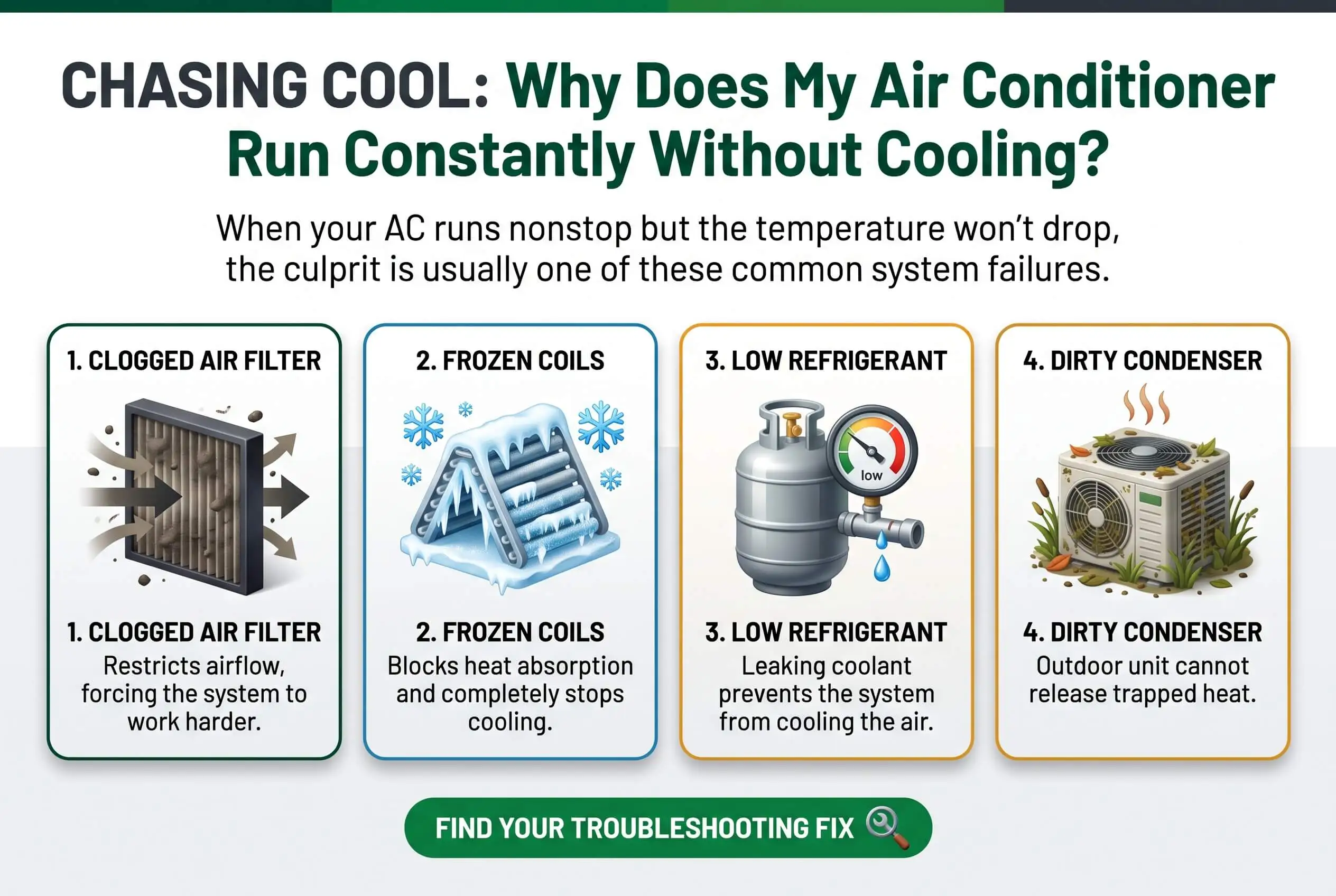
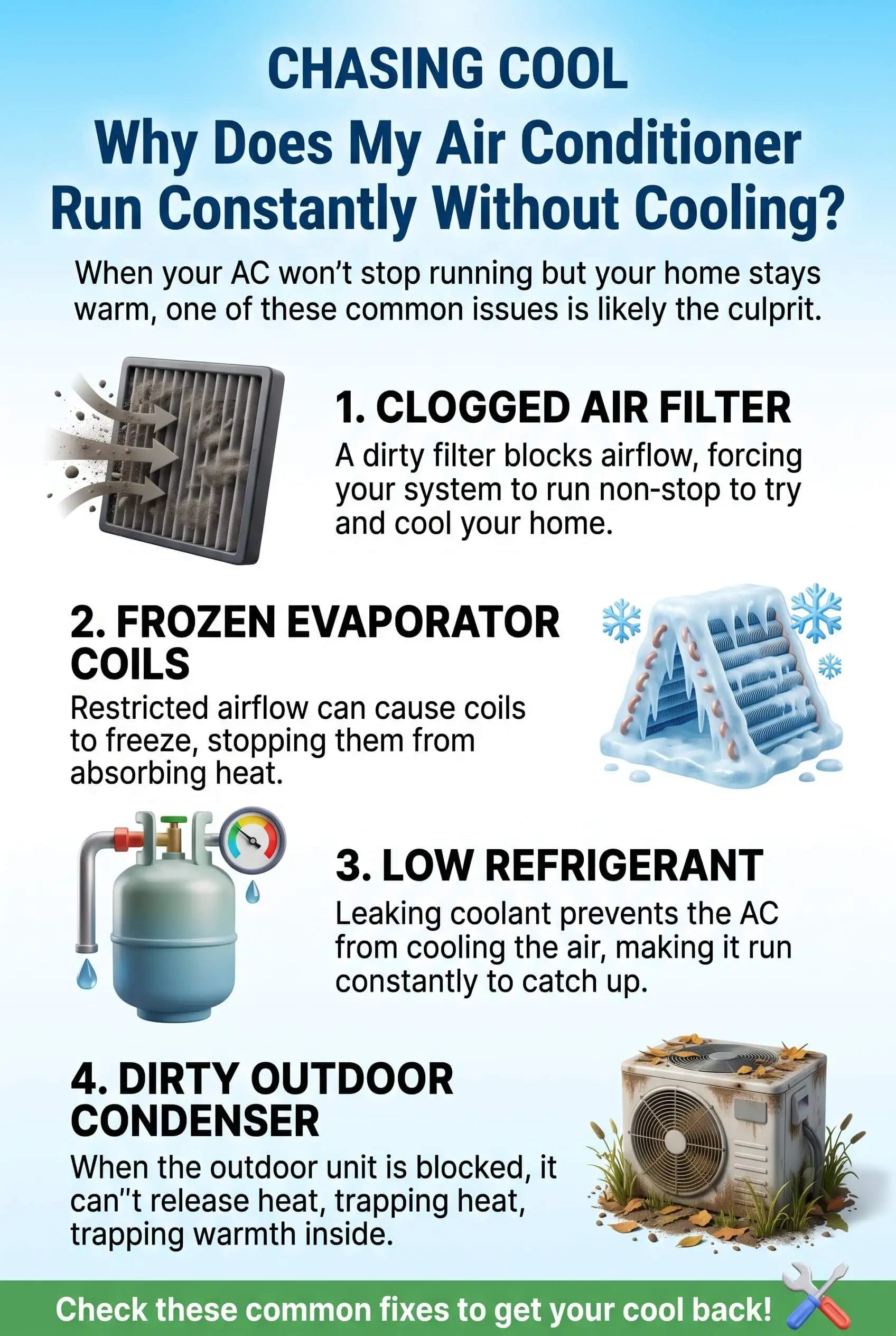
A Clogged Air Filter
A loaded filter chokes the air reaching the evaporator coil. Your system runs longer and cools less. A filter that's too restrictive for your equipment can cause the same symptoms, so check your owner's manual for the highest MERV rating your system can handle before you upgrade.
Pro tip: Write the install date on the filter frame of your MERV 8 pleated furnace air filters with a marker so you know at a glance how long they've been working.
A Frozen Evaporator Coil
When airflow drops far enough, the coil can fall below freezing, and the frost blocks even more air. Check the larger copper line near the indoor unit for ice. Thaw it on Fan Only for several hours without chipping at the ice, then put in a fresh filter before you restart on Cool. Ice that comes back with a clean filter usually points to low refrigerant.
Blocked Returns and Leaky Ducts
A couch parked over a return vent or a few closed registers can starve your system of air. Leaky attic ducts are sneakier, dumping cooled air where you'll never feel it. Getting little or no air at the vents is a separate problem, and the first guide in Essential Resources below covers it.
Outdoor Unit Problems That Trap Heat Inside
A Dirty Condenser Coil
Grass clippings and dust pack into the outdoor fins and keep heat from escaping. Shut off power at the disconnect, rinse the fins gently with a garden hose, and keep plants trimmed back about two feet. Leave the pressure washer in the garage.
A Failed Capacitor or Contactor
These two parts get the outdoor fan and compressor going. Listen for a unit that hums while the fan sits still, or a fan that spins while the compressor stays silent. Capacitors can hold a dangerous charge even after you cut the power, so this repair belongs to a technician.
Low Refrigerant Is a Job for a Licensed Pro
Your AC doesn't burn through refrigerant the way a car burns gas. If the charge runs low, it's leaking somewhere. Watch for hissing near the lines, ice that returns after a full thaw, or cooling that fades a little more each week. Federal rules allow only certified technicians to handle refrigerant, and topping off a system without fixing the leak just postpones the next breakdown.
When Your House Works Against Your AC
A healthy system can still lose the battle. An undersized unit, ductwork running uninsulated through a baking attic, or big windows soaking up afternoon sun can keep your AC running nonstop. A load calculation shows whether your system fits your home. If you also notice a musty AC smell, check for moisture or mould buildup that may need attention.
When to Turn It Off and Call a Technician
A struggling system wears down the compressor, the most expensive part to replace. Shut it down and call a licensed technician when you notice:
The breaker trips more than once
A burning or chemical smell near either unit
Hissing or bubbling near the refrigerant lines
Ice that returns after a full thaw and a fresh filter
Water stains on drywall or ceilings near the indoor unit
"In the summer service calls I've run, the system that won't shut off usually has a coil problem the homeowner can't see. A loaded filter lets the evaporator coil drop below freezing, a thin layer of frost insulates it, and the blower keeps pushing air across a coil that can no longer absorb heat. Swap the filter and thaw the coil first, because that one sequence tells you whether you have an airflow problem or a refrigerant leak."
Essential Resources
1. When Your AC Runs but No Air Comes Out
Matches each no-airflow symptom to its likely cause and the check to run first.
Source: AC running but no air coming out
2. EPA Rules on Refrigerant Handling
Federal rules on refrigerant and technician certification. Read it before you hire anyone for a leak repair.
Source: EPA Section 608: Stationary Refrigeration and Air Conditioning
3. A Home Inspector's Maintenance Checklist
Home inspectors lay out the upkeep that heads off most cooling failures.
Source: Central Air-Conditioning System Inspection
4. What a Proper Service Visit Should Include
Spells out which jobs belong to you and which belong to a technician.
Source: Air Conditioner Repairs and Maintenance (Minnesota Department of Commerce)
5. Is Your System Sized for Your Home?
Explains ACCA Manual J, the method contractors use to size home cooling equipment. Start here if everything else checks out.
Source: ACCA Manual J: Residential Load Calculation
6. Staying Safe While Your AC Is Down
Ways to keep your household safe in extreme heat while you wait on a repair.
Source: Prepare for Extreme Heat (Ready.gov)
7. Why Leaky Ducts Waste Cooling
Shows how duct leaks waste the air you paid to cool.
Source: Seal and Insulate Ducts (HUD)
Supporting Statistics
1. A clean filter can cut cooling energy use by 5% to 15%. The U.S. Department of Energy reports that swapping a dirty, clogged filter for a clean one lowers an air conditioner's energy use by that much.
Source: Maintaining Your Air Conditioner (U.S. Department of Energy)
2. Leaky ducts lose 20% to 30% of the air moving through them. ENERGY STAR estimates that a typical house loses that share to leaks, holes, and poorly connected ducts.
Source: Duct Sealing (ENERGY STAR)
3. 88% of U.S. households use air conditioning. That figure comes from the U.S. Energy Information Administration's 2020 Residential Energy Consumption Survey.
Source: Nearly 90% of U.S. Households Used Air Conditioning in 2020 (EIA)
Regular maintenance for air conditioning helps improve cooling efficiency and reduce energy waste. Replacing dirty filters can lower AC energy use by 5% to 15%, while sealing leaky ducts can prevent the loss of 20% to 30% of conditioned air, benefiting the 88% of U.S. households that use air conditioning.
Final Thoughts and Opinion
In my view, the order you check things matters more than any single fix. Start with settings, then the filter, then the outdoor unit, and save the parts that need a technician for last.
Airflow is behind most of these cases, and airflow is the part you control. Ice on the lines tells you something upstream went wrong, so treat it as a clue rather than the cause. And refrigerant never needs a routine top-off, because a low charge always means a leak.
You're the one who keeps this house running. A monthly filter check through summer and a spring tune-up keep these problems from showing up on the hottest day of the year.
Frequently Asked Questions
What should I do if my air conditioner is not blowing cold air but running?
Set the thermostat to Cool with the fan on Auto, replace the filter if you can't see light through it, and confirm the outdoor unit is running. If the air stays warm, check for ice on the refrigerant lines and call a technician.
Should I turn off my AC if it's running but not cooling?
Yes, if you see ice, smell burning, or the breaker trips, since running it strains the compressor. Otherwise, switch to Fan Only while you check the filter and outdoor unit, then restart on Cool.
Can a dirty air filter make my AC run all the time?
Yes. A clogged filter restricts airflow across the evaporator coil, so the system runs longer to move the same heat. In bad cases the coil freezes and cooling nearly stops. A new filter is the cheapest place to start.
Why is my outside unit running but no cold air is coming inside?
Look indoors first. A frozen evaporator coil, a clogged filter, a tripped condensate float switch, or a failed blower motor can each keep cold air from reaching your vents while the outdoor unit hums along.
How long should an AC run on a hot day?
On a typical summer day, a healthy system cycles on and off several times an hour. In extreme heat, running for hours is fine. Constant running on mild days is your signal to start checking.
Get Your Home Cooling Again
Your AC runs constantly without cooling for a reason, and you now know how to track it down, starting with the filter and working your way outdoors. Take the checks one at a time, and you'll either have cold air back or know exactly what to tell your technician when looking for the best air conditioning repair service.


