On an alert day, the cleanest air within your reach usually isn’t somewhere else in Minnesota. One positive thing about air quality Minnesota conditions is that you can often improve the air you breathe indoors by keeping a decent filter running, and the closest place to do that is probably your own house. That’s the whole thing. It’s invisible, which is exactly why so few people use it.
TL;DR Quick Answers
Air Quality Minnesota
Minnesota air is good most of the year. The trouble comes in bursts, on the alert days when the index is forecast above 101 and wildfire smoke from Canada settles over the state. On those days the filter in your house matters more than the county you're standing in.
Alert threshold: the state issues an alert when the index is forecast above 101 in any of its 18 forecast regions.
Main driver: wildfire smoke drifting down from Canada, plus ground level ozone on hot, still afternoons.
Above 100, sensitive groups scale back. Above 150, everybody moves indoors.
Ozone clears after sunset. Smoke clears on no schedule at all.
Best free public option: your local library or community center.
Best option overall: one sealed interior room at home with the fan switched on and a high efficiency filter running.
Driving away from a smoke event usually fails, because the plume is bigger than the drive.
Change your filter far more often than usual through smoke season.
Top Takeaways
The cleanest air during an alert is indoors and filtered, not somewhere else in the state.
Libraries and community centers are the strongest free public option, and the state health department recommends them by name.
One interior room, windows closed, fan on instead of auto, good filter, portable cleaner. That beats almost anywhere you could drive.
Smoke and ozone are different problems. Ozone eases after dark. Smoke doesn’t.
Smoke loads a filter in weeks rather than months, so check it monthly through the season.
Set all of this up before the haze arrives. Every step gets harder to arrange mid alert.
What a Minnesota Air Quality Alert Actually Means
The Minnesota Pollution Control Agency issues an alert when the air quality index is forecast to climb past 101 anywhere in its 18 forecast regions. Past that line, the color tells you more than the number does. Orange means kids, older adults, and anyone with asthma or heart disease should pull back from outdoor plans. Red means everybody feels it. At purple and maroon, outdoors is off the table and the only question left is where you can go to breathe filtered air.
One distinction reshapes your entire day, and hardly anyone makes it. Smoke and ozone don’t behave alike. Smoke rolls in at any hour and parks for days, whether or not the sun is up. Ozone builds through hot, still afternoons and fades once it gets dark. So an early morning walk is usually fine on an ozone day and a genuinely bad idea on a smoke day.
Check the Number Before You Pick a Destination
Alert boundaries here are regional, not statewide. The reading two counties over can sit a full color apart from yours, which makes “is there an alert today” the wrong question to ask. Pull up a live air quality index map for Minnesota and read the monitor closest to you instead of a statewide average.
Watch two things while you’re there. The number, and which pollutant is pushing it. The number climbs well before the sky changes, and understanding air pollution effects starts with paying attention to that reading. Faint haze and that burnt smell can trail the actual reading by hours, so on a questionable day I trust the monitor over my own eyes. Every time.
Public Places That Reliably Hold Cleaner Indoor Air
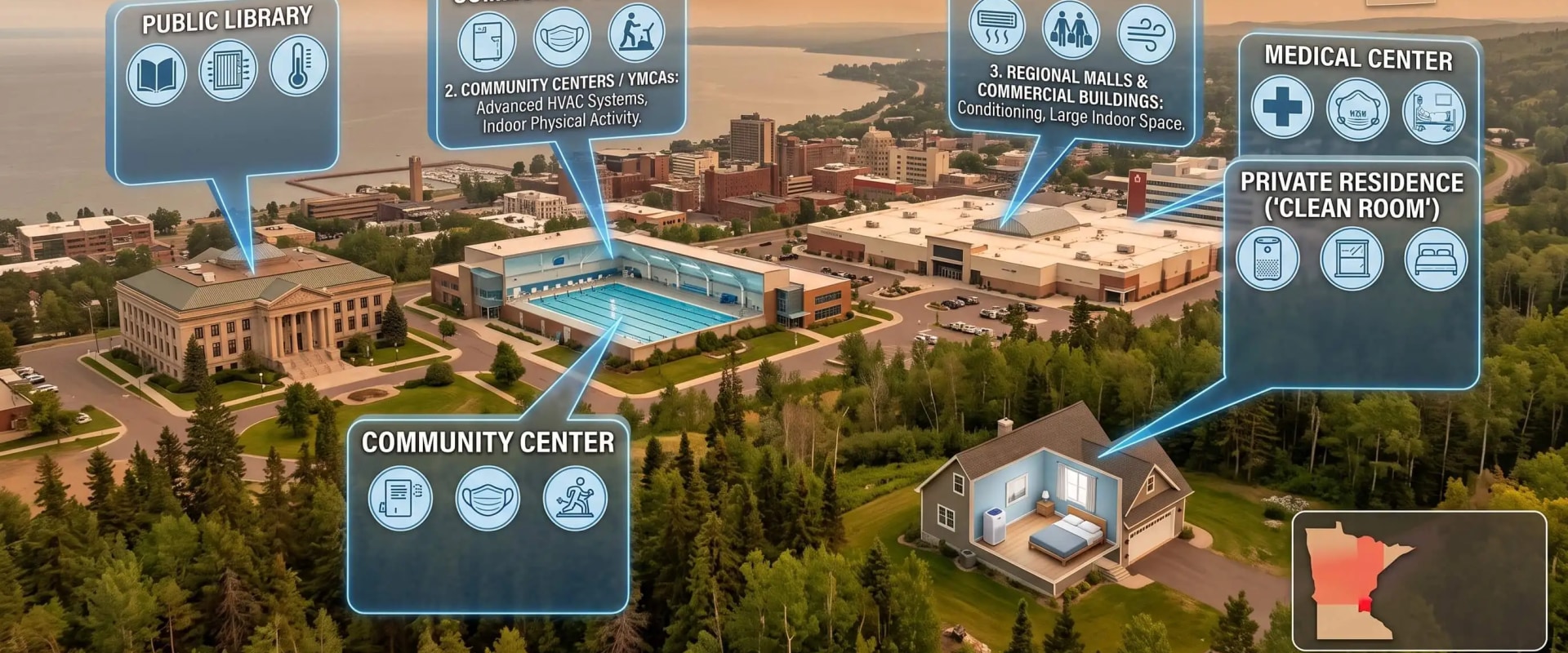
Minnesota has no formal statewide clean air shelter network, so nobody’s going to announce an official refuge on the evening news. What exists instead is a handful of buildings that happen to be very good at this almost by accident, because commercial heating and cooling equipment runs heavier filtration and moves far more air per hour than anything in a house does.
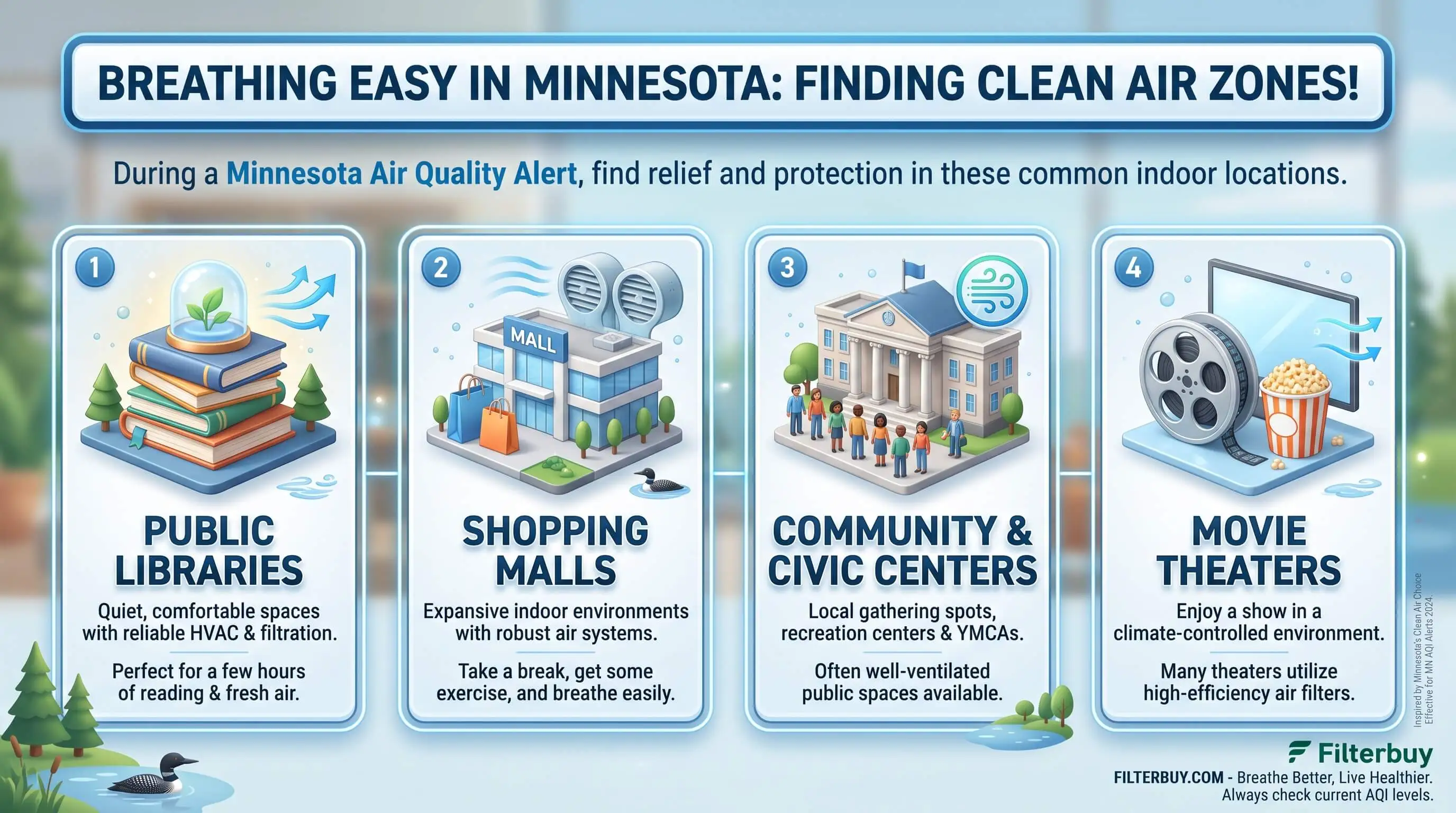
Libraries and community centers sit at the top of that list, and the state health department names them directly in its own smoke guidance. They’re free, they’re air conditioned, nobody asks why you’re there, and there’s usually room for a kid to spread out for a few hours.
Large enclosed shopping centers work on the same principle and stay open later. Medical office buildings and hospital lobbies run some of the tightest filtration you’ll find anywhere the public can simply walk in. Municipal rec centers and cinemas hold up well too.
One caution matters more than the rest. Any building with propped doors and constant foot traffic hands most of that advantage back, so a small shop with the front door open all afternoon is barely better than standing on the sidewalk. And call ahead before you drive anywhere with an older parent or a kid who has asthma. Summer hours shift without warning, and a locked library at the end of a hot drive helps nobody.
Building the Cleanest Room in Your Own House
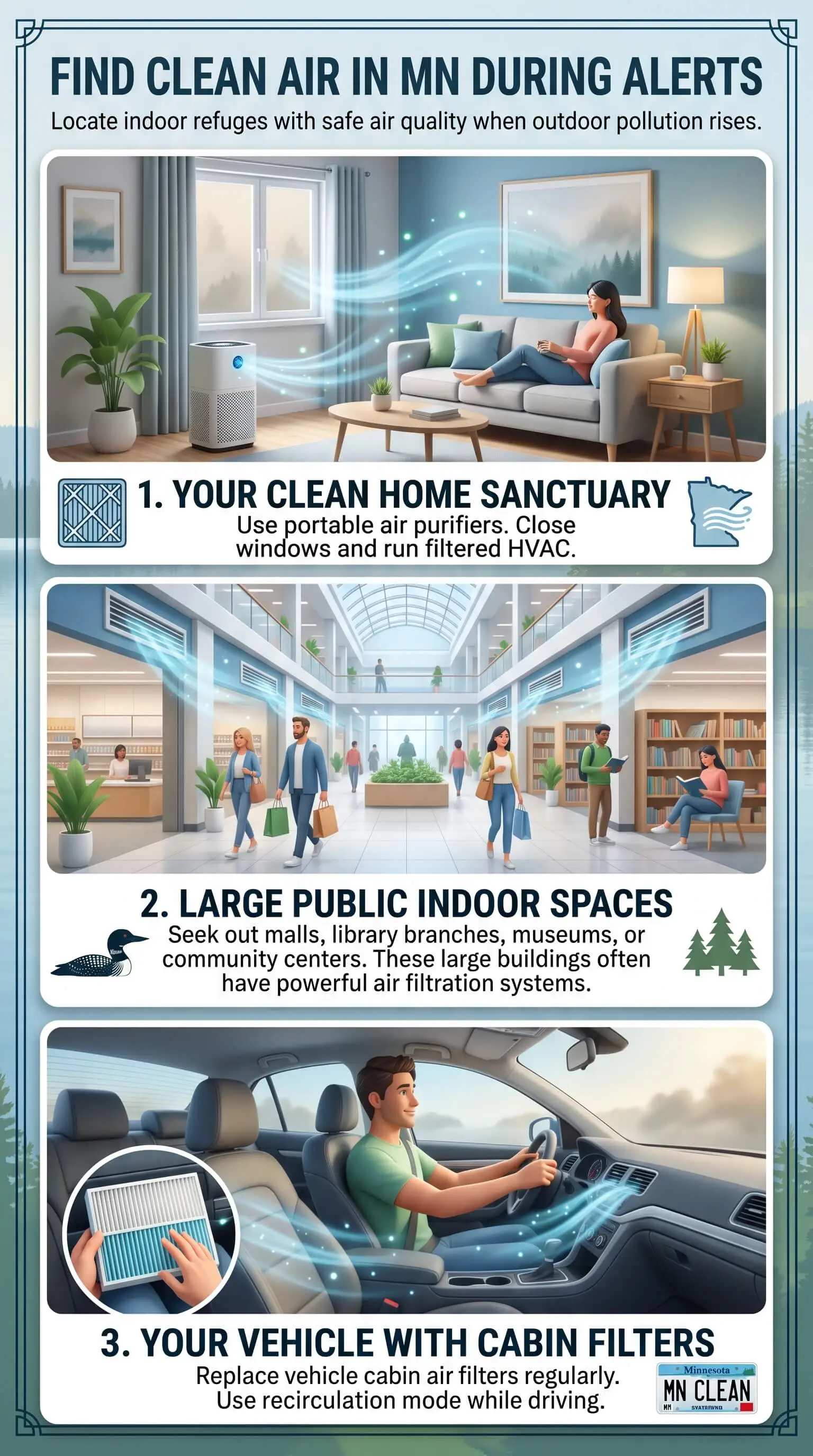
For most families, this beats going anywhere at all. Pick one interior room, ideally a bedroom without much exterior wall, and make it the room everybody retreats to.
Close the windows and keep them closed. Overnight too, even when the temperature finally drops and that cool breeze feels like a gift after a long day. On a smoke night, the breeze is carrying the exact particles you’re trying to keep out of the house.
Then switch the system fan from auto to on. Almost everyone skips this step, and it’s the one that changes the most. Auto only runs the fan when the house calls for heating or cooling, which on a mild smoky day might be almost never, and a filter can only clean the air that actually passes through it. Flip that switch and your existing equipment turns into a cleanup loop that runs all day.
Fit the highest efficiency filter your system will take, then add a portable cleaner sized to that one room. Two layers. One covering the whole house, one covering the room where people sleep.
Now check that filter sooner than you normally would. Smoke loads a filter fast. I’ve pulled filters after a heavy stretch that came back gray and stiff in a couple of weeks when they’d ordinarily last months. A clogged filter quits protecting you and starts straining the equipment, which turns one problem into two.
What Your Car Can and Can’t Do
A car makes a decent bridge and a poor destination. Set the climate control to recirculate so the system stops pulling outside air through the vents, and check the cabin filter while you’re thinking about it. That’s the most ignored filter most people own.
It’ll get you cleanly from the driveway to the library. It won’t get you through an afternoon, because the cabin volume is small, carbon dioxide builds up on recirculate, and nobody designed a car to be a shelter.
Why Driving Away From the Smoke Rarely Works
Plumes drifting down from Saskatchewan, Manitoba, and Ontario routinely blanket most of Minnesota at once, on a scale that outruns any day trip you could plan. During the worst stretches, the alert covers essentially the whole state and the Tribal Nations within it.
Regional variation is real, but you can’t plan a drive around it. The same afternoon can read clear along the North Shore and orange in the metro, then flip completely the next day as the wind shifts. By the time you’ve driven three hours toward the clean number, the map has already moved.
Who Needs Cleaner Air First
If you’re triaging a household, the order is clear. Children, older adults, anyone pregnant, and anyone living with asthma, COPD, heart disease, or diabetes feel these days first and hardest. Build a clean room around them, with filtration and airflow checked by a trusted HVAC company if needed. Pick the library trip around them too. And if somebody in that group starts coughing, gets short of breath, or seems oddly wiped out on an alert day, call their doctor rather than waiting it out.
“Every smoke season I watch people treat this as a geography problem when it’s a building problem. They burn a whole day driving and arrive somewhere just as hazy, tired and breathing the same air, while the fix sat in the utility closet the entire time. One room, windows shut, fan flipped from auto to on, a good filter in place. That’s better air than anywhere they could’ve driven to. The households that ride out these weeks in comfort are the ones that set it up in June, before the first haze ever showed up.”
7 Essential Resources
EPA AirNow gives you the official current reading for your ZIP code or nearest monitor, straight from the agency that sets the scale.
The AirNow Fire and Smoke Map shows you where the smoke actually sits, so you can see a bad day coming instead of discovering it on your front step.
MPCA current air quality conditions pull from the state monitoring network for the most local read on fine particles and ozone.
The Minnesota Department of Health wildfire smoke guide lays out who’s most at risk and what to do at each level in plain language. It’s also where the advice to head for a library or community center comes from.
The EPA guide to creating a clean room during wildfire smoke is the closest thing to a step by step for the room strategy above.
The Minnesota DNR State Climatology smoke journal compares recent smoke outbreaks against fifty years of records, which helps when you’re weighing how seriously to take a forecast.
The National Weather Service air quality alert feed carries the alert text as issued, including the exact counties and the expiration time.
3 Statistics
723,418 Minnesota children live in places with unhealthy air, and the Twin Cities metro earned an F grade and ranked 39th worst in the nation for short term particle pollution. Source: American Lung Association, State of the Air 2026.
Roughly 28 million people in the United States live with asthma, and air quality ranks among the risk factors that most shape how manageable it is where you live. Source: Asthma and Allergy Foundation of America.
Climate change made the extreme heat behind the recent fires up to five times more likely, which is why these smoke events keep running longer rather than shorter. Source: Yale Climate Connections.
With more Minnesota children facing unhealthy air, millions of Americans living with asthma, and wildfire smoke events lasting longer, choosing the best home AC filters can be a practical way to help reduce indoor particle exposure when outdoor air quality drops.
Final Thoughts and Opinion
Here’s my opinion, and I’ll own it. Minnesota still treats smoke like weather, something you check on and put up with, when it’s become closer to a season you plan around.
The public side of this is thin. No coordinated list of clean air spaces, no standard signage, nothing that tells a person with COPD where to go on a maroon day. Libraries and community centers are quietly doing that work without anyone asking them to, which holds up right until the day it doesn’t.
Until that changes, this lands on households, and honestly the household version is cheap and it works. One room. One fan setting. One decent filter bought before the smoke arrived. Those are also some of the simplest benefits of regular maintenance for your HVAC system. I’d rather see a hundred homes do that in June than a thousand people hunting for somewhere to drive in July.
Where can I go during a Minnesota air quality alert?
Public libraries and community centers are your strongest free option, followed by large enclosed shopping centers, medical office buildings, and municipal rec centers. They all run commercial filtration that outperforms a typical house. Call ahead to confirm hours, especially if you’re bringing someone who reacts badly to smoke.
Is it safe to go to a mall or library when the AQI is over 150?
Sitting inside a well filtered building beats standing outdoors at that level, so yes, it’s a reasonable call. What matters is how long you’re outside getting there and back. Park close, keep the car on recirculate, and don’t linger in the lot.
Can I drive somewhere with better air quality in Minnesota?
Once in a while, but I wouldn’t build a plan around it. Smoke plumes regularly cover most or all of the state at once, and regional readings can reverse within a day as the wind shifts. You’re more likely to spend three hours driving into conditions no better than the ones you left.
How do I make one room in my house safe during smoke?
Choose an interior room, close and keep closed every window and the door, switch the system fan from auto to on so air keeps cycling through the filter, fit the highest efficiency filter your system accepts, and add a portable cleaner sized to that room. Then check the filter monthly through smoke season and replace it earlier than you normally would.
How long do Minnesota air quality alerts usually last?
Ozone alerts often run a single afternoon and lift by evening. Smoke alerts are the long ones. They routinely stretch across several days and occasionally past a week when a fire is large and the wind pattern holds. The alert text always carries an expiration time, though extensions happen often.
What to Do Next
Take five minutes today, before the next alert lands. Check your current reading and note which pollutant is pushing it. Pick the room that’ll become your clean room. Decide right now which library or community center you’d head to if that room isn’t enough.
Then go look at the filter sitting in your system. If you can’t remember when it went in, that’s your answer. Replacing it with fresh MERV 8 pleated HVAC furnace air filters before smoke season is the cheapest protection you can buy, and it’s the one step that has to happen ahead of time instead of during.